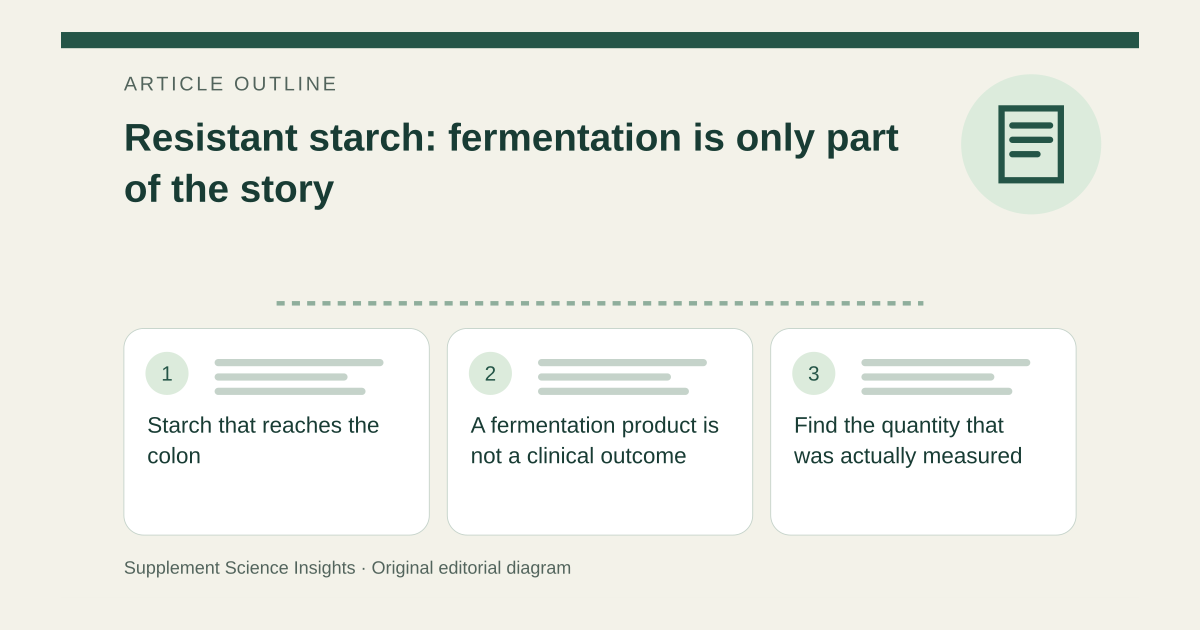
Starch that reaches the colon
Resistant starch escapes digestion in the small intestine and can be used by microorganisms in the colon. Sources include foods such as legumes, green bananas and some cooked-and-cooled starches. Processing and preparation can change the amount present. [1]
The term describes a digestive property, not one uniform supplement. A food, flour and isolated starch can differ substantially, so their total weights should not be treated as equivalent resistant-starch amounts. [1]
A fermentation product is not a clinical outcome
Microbial fermentation of resistant starch can produce short-chain fatty acids, including butyrate. This helps explain research interest, but it does not mean that every resistant-starch product prevents disease or improves symptoms in every person. [1]
A study measuring bacterial abundance or a fermentation product answers a different question from one measuring pain, bowel function or a diagnosed disease outcome. The pathway can be biologically interesting while the practical benefit of a particular preparation remains uncertain. [1]
Find the quantity that was actually measured
When assessing a powder, distinguish serving mass, total carbohydrate, dietary fiber and any separately declared resistant-starch content. These are different measurements. A bag containing 500 grams of flour does not establish that it contains 500 grams of resistant starch.
For a study comparison, also record how the food or powder was prepared. Do not create a home recipe by assuming that cooling any starch produces a fixed percentage. Without a composition measurement for that preparation, the exact amount remains unknown.
Tolerance is part of usefulness
Adding fermentable material can cause gas or bloating. Cleveland Clinic advises introducing prebiotic foods gradually. NIDDK likewise notes that adding too much fiber at once can trigger symptoms in people with irritable bowel syndrome and recommends individualized dietary changes. [1][2]
If you already follow a therapeutic diet for digestive symptoms, discuss a concentrated starch product with your clinician or dietitian. Persistent worsening is not evidence that a supplement is cleansing the gut or working harder. [1][2]
Do not turn a scoop into a resistant-starch dose
Imagine a hypothetical flour serving weighs 20 grams and its label separately reports eight grams of resistant starch. A ten-gram half serving would provide four grams if the product is uniformly mixed and the label basis remains the same.
Another flour listing only 20 grams per serving cannot be assigned the same eight-gram content. The first label supports a composition calculation; the second leaves that detail unknown. Neither calculation establishes a treatment dose, and changes in preparation could make a different comparison necessary. Write down the measurement basis before applying the arithmetic. A carbohydrate total alone cannot supply that missing resistant-starch measurement for an unfamiliar flour.
| Hypothetical serving | Powder mass | Declared resistant starch |
|---|---|---|
| Full serving | 20 g | 8 g |
| Half serving | 10 g | 4 g |
Sources for this article
- Cleveland Clinic — What Are Prebiotics?
Source consulted: 2026-09-17. This is a reference resource, not a claim that we conducted the studies or tested a product. - NIDDK — Eating, Diet and Nutrition for Irritable Bowel Syndrome
Source consulted: 2026-09-17. This is a reference resource, not a claim that we conducted the studies or tested a product.