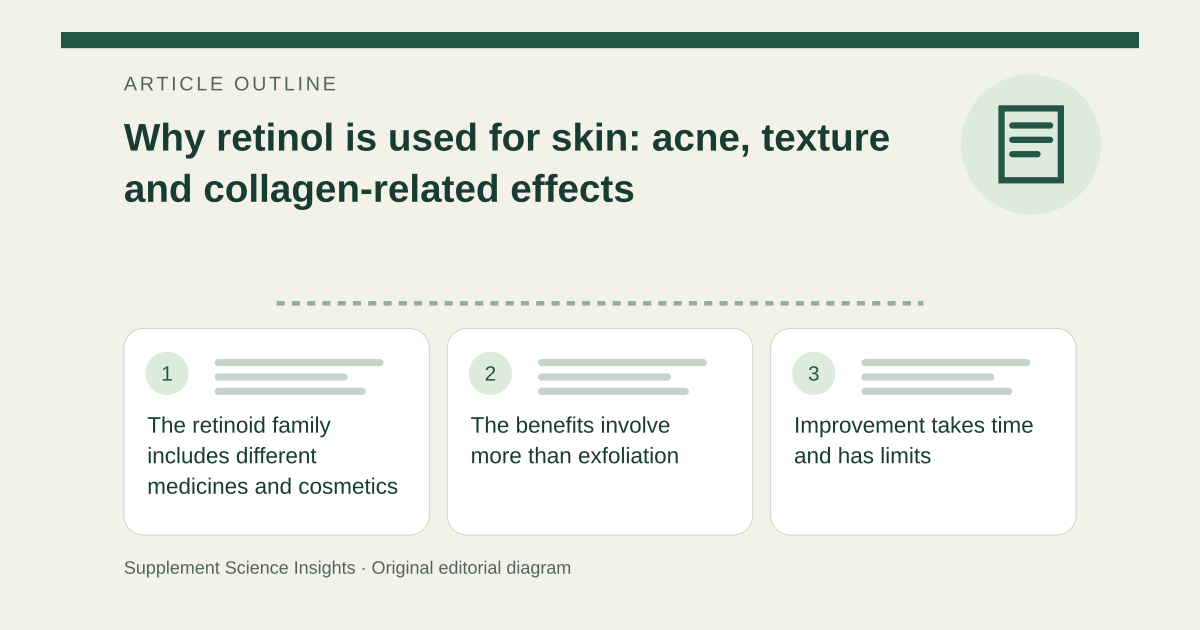
The retinoid family includes different medicines and cosmetics
The American Academy of Dermatology distinguishes over-the-counter retinol from prescription tretinoin and other retinoids. Adapalene is available in both prescription and nonprescription forms. Do not treat every vitamin A derivative as the same product or substitute an oral vitamin supplement for a topical treatment. [1]
The benefits involve more than exfoliation
Retinoids affect skin-cell turnover, and some help prevent clogged pores. They can also support collagen-related changes associated with improvements in fine lines and texture. The ingredient and formulation matter: the effects of a prescription acne medicine cannot be promised for every cosmetic retinol serum. [1][2]
Improvement takes time and has limits
MedlinePlus explains that tretinoin may reduce fine wrinkles but does not erase them or completely repair sun damage; visible improvement may take months. That prescription information is not an exact timetable for every retinol product. Increasing frequency beyond directions can increase irritation rather than speed success. [2]
Tolerability and pregnancy change the choice
Dryness, peeling and irritation can occur. Follow the specific directions and discuss persistent reactions or inflammatory skin conditions with a dermatologist. AAD advises against retinoids during pregnancy. Sun protection remains part of care; a retinoid does not replace it. [1][2]
Choose one goal and an appropriate formulation
Imagine seeking help for clogged pores while a friend wants to address fine lines. The same bottle need not be the right choice for both. A suitable formulation, tolerable routine and realistic outcome matter more than the strongest available percentage. [1][2]
| Question | Why it matters |
|---|---|
| Acne or cosmetic texture goal? | Treatment evidence differs |
| Prescription or cosmetic formula? | Directions are not interchangeable |
| Pregnancy or irritated skin? | May change suitability |
Sources for this article
- Retinoid or retinol?
Source consulted: 2026-09-21. This is a reference resource, not a claim that we conducted the studies or tested a product. - Tretinoin Topical: MedlinePlus Drug Information
Source consulted: 2026-09-21. This is a reference resource, not a claim that we conducted the studies or tested a product.