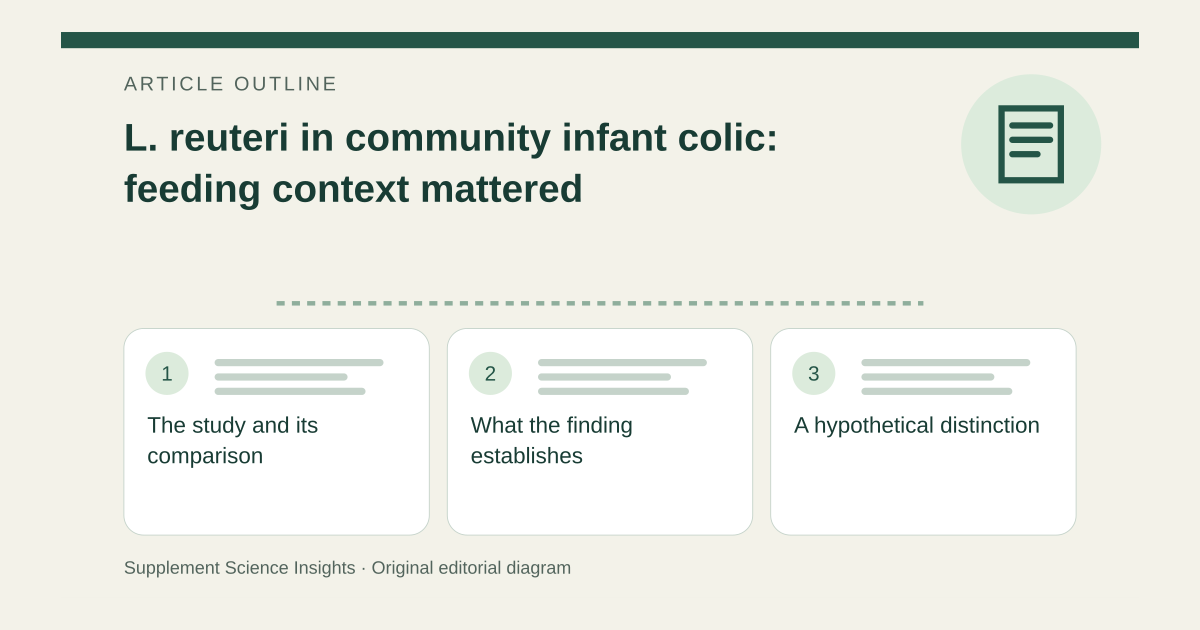
The study and its comparison
A blinded Australian trial randomized 167 infants younger than three months with colic to L. reuteri DSM17938 or placebo for one month. It included both breastfed and formula-fed infants; 127 reached the primary assessment. [1]
Crying and fussing decreased in both groups, but the probiotic group had forty-nine minutes more per day at one month. The difference mainly reflected fussing, especially among formula-fed infants. Secondary outcomes were similar. [1]
What the finding establishes
Follow-up loss and feeding subgroups limit interpretation, and the result does not settle every selected breastfeeding population. NHMRC supported investigators; nutrition-industry advisory relationships were disclosed. This is evidence against a blanket claim of colic benefit, not proof that every strain has identical effects or that unexplained infant distress should be managed without assessment. [1]
A hypothetical distinction
Imagine feeding groups respond differently. A result from one group cannot automatically be extended to every infant.
| Detail | Interpretation |
|---|---|
| Measured outcome | Keep the endpoint specific |
| Study preparation | Not every retail product |
| Remaining uncertainty | Not resolved by a mechanism |
Sources for this article
- Treating infant colic with the probiotic Lactobacillus reuteri: double blind, placebo controlled randomised trial.
Source consulted: 2026-09-19. This is a reference resource, not a claim that we conducted the studies or tested a product.