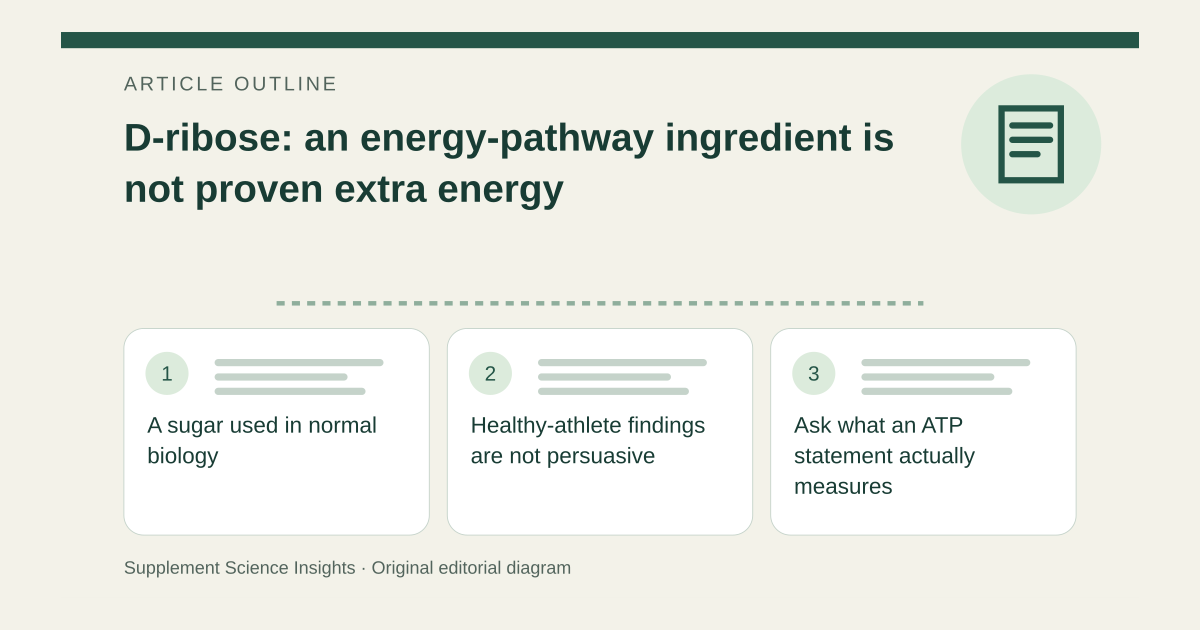
A sugar used in normal biology
D-ribose is a five-carbon sugar involved in compounds such as ATP, the molecule used in cellular energy transfer. This biochemical role is a reason to study ribose, but it does not show that swallowing extra ribose improves how a healthy person feels or performs. [1]
A pathway diagram establishes where a molecule participates. It does not establish that availability of that molecule is the limiting factor in a person's fatigue or exercise capacity. [1]
Healthy-athlete findings are not persuasive
The NIH Office of Dietary Supplements describes limited research that does not provide strong support for ribose as an exercise-performance supplement. Small studies using different protocols cannot justify a broad claim that ribose increases strength, speeds recovery or reliably restores energy. [1]
Keep outcomes separate. A biochemical measurement, a subjective fatigue score and a repeated-sprint result are different endpoints. A change in one cannot stand in for a benefit in all three. Evidence from a medical population also cannot automatically be applied to a healthy athlete. [1]
Ask what an ATP statement actually measures
A package may mention ATP without reporting that researchers measured a meaningful performance improvement. Ask whether the evidence concerns the ingredient's normal role, a laboratory experiment or a controlled human comparison using a similar preparation.
For a personal decision, define the problem before evaluating the proposed solution. Persistent fatigue, a difficult training session and insufficient food intake are not interchangeable situations. A marketing term such as cellular energy does not identify which problem a product has been shown to address.
Limited efficacy evidence is not a safety certificate
ODS notes that long-term safety of supplemental ribose has not been adequately studied. Short studies with few participants have limited ability to detect uncommon harms or establish suitability for people with medical conditions. [1]
If unexplained fatigue is the reason for considering a supplement, seek an assessment rather than repeatedly escalating a powder. Discuss the full product with a clinician if you take medicines or are following a medical nutrition plan. A sugar's presence in normal metabolism does not prove concentrated use is appropriate. [1]
A blend total does not reveal the ribose amount
Imagine a hypothetical energy blend lists 5,000 milligrams per serving and names ribose, creatine and taurine without individual quantities. You know the blend's total weight, but not how much ribose it supplies.
Dividing the total equally among the three ingredients would be an invented estimate. Even a disclosed ribose amount would still need appropriate clinical evidence; a transparent number solves the composition question, not the effectiveness question. Keep both questions visible when comparing labels. A front-label energy claim does not supply any of those missing amounts.
| Label information | Defensible conclusion |
|---|---|
| 5,000 mg blend | Combined weight only |
| Three named ingredients | Individual amounts unknown |
| ATP wording | Not proof of a performance benefit |
Sources for this article
- NIH ODS — Exercise and Athletic Performance, professional fact sheet
Source consulted: 2026-09-17. This is a reference resource, not a claim that we conducted the studies or tested a product.