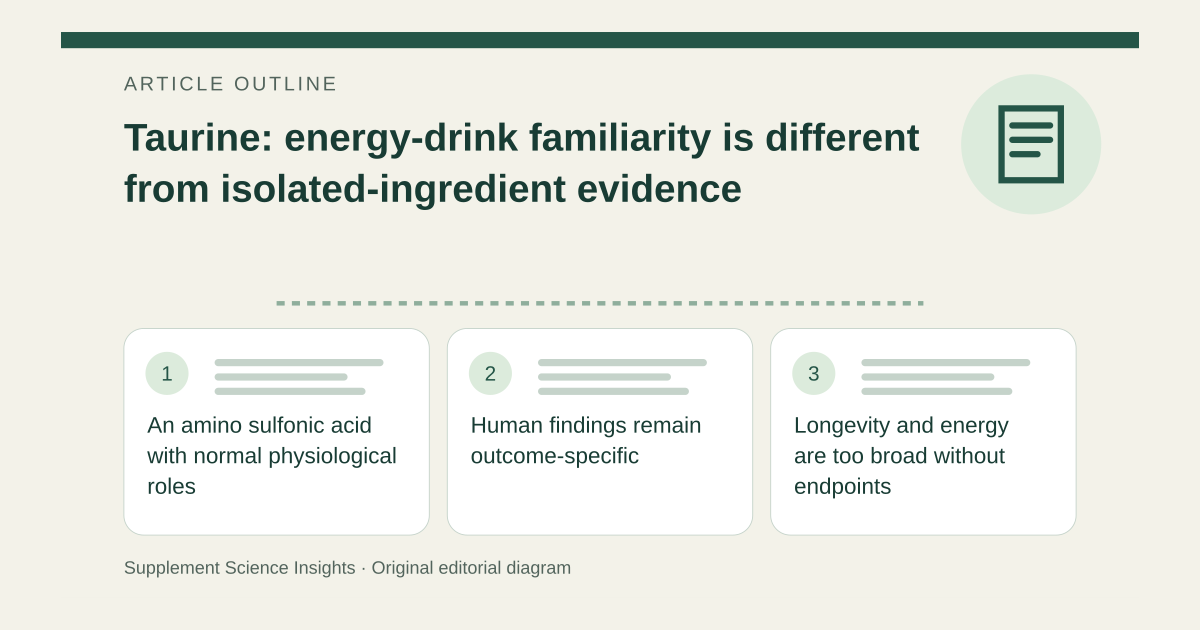
An amino sulfonic acid with normal physiological roles
Taurine is present in many tissues and can be synthesized by the body. It is found in foods and is also sold as a supplement or included in energy drinks. It is not interchangeable with caffeine simply because the two appear on the same beverage label. [1]
A product comparison should record taurine separately from caffeine, sugar and other ingredients. The effect of a complete beverage cannot be assigned to taurine alone without an appropriate study. [1]
Human findings remain outcome-specific
Memorial Sloan Kettering describes mixed exercise-performance findings and preliminary research in several metabolic or clinical settings. Animal muscle findings should not be treated as demonstrated muscle growth in humans. [1]
Food-intake associations are also different from starting a concentrated supplement. A cardiovascular association among people eating taurine-containing foods cannot isolate taurine from the rest of their diet and lifestyle. It therefore does not establish that a capsule reproduces the association. [1]
Longevity and energy are too broad without endpoints
A claim about energy might refer to alertness, a laboratory metabolic measure, less fatigue or better exercise performance. Those are different questions. A change in one cannot supply the others simply because a product belongs to an energy category.
Likewise, a biomarker associated with aging does not directly measure extended human lifespan. For any broad claim, ask what changed in people, how it was measured and how long the study lasted. A mechanistic explanation can suggest a hypothesis without establishing a practical benefit.
Combination reports need careful attribution
Serious adverse events have been reported after excessive energy-drink intake, sometimes with alcohol. Such reports involve complete products and cannot isolate taurine as the cause. They also do not justify assuming that every combination is harmless. [1]
Taurine may add to blood-pressure-lowering effects in relevant treatment settings. Review the full product and medicines professionally. This page does not provide a regimen for combining taurine, stimulants or alcohol, and a short tolerability study is not a universal safety assurance. [1]
A beverage study does not isolate one listed ingredient
Imagine a fictional study compares an energy drink containing caffeine, taurine and sugar with plain water. A difference in alertness cannot establish taurine's independent effect because several components differ at once.
A more informative design would need comparisons that address the individual contribution. The example explains attribution; it does not recommend a beverage or suggest that a larger taurine number predicts a stronger effect.
| Hypothetical comparison | Attribution limit |
|---|---|
| Energy drink versus water | Several ingredients differ |
| Alertness changed | Taurine contribution unknown |
| Isolated taurine claim | Needs an isolating comparison |
Read the complete formula and the precise outcome
This overview does not recommend taurine for longevity, weight loss or athletic performance. Normal physiological roles, isolated supplement trials and energy-drink reports should remain separate evidence categories. The useful claim is the one that identifies a measured outcome without assigning an entire product's effect to one component.
Sources for this article
- Memorial Sloan Kettering — Taurine
Source consulted: 2026-09-17. This is a reference resource, not a claim that we conducted the studies or tested a product.