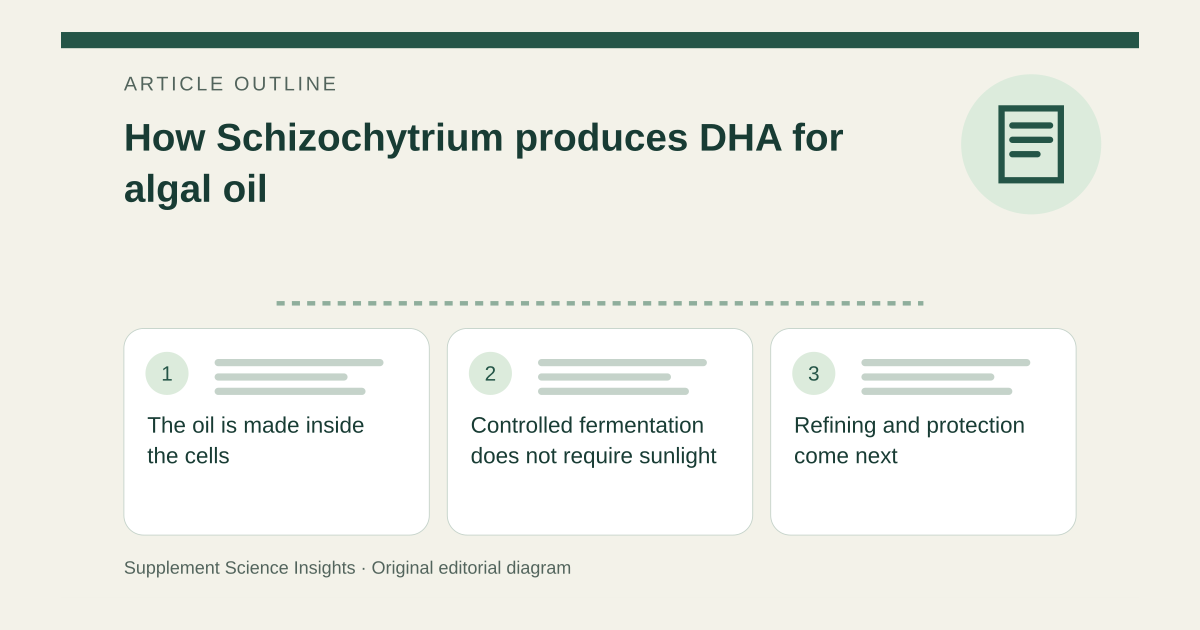
The oil is made inside the cells
Schizochytrium is a source organism used to produce DHA-rich algal oil. Manufacturers cultivate selected strains, recover the oil accumulated in their cells, and refine it into a food ingredient. This allows DHA production without extracting the finished oil from fish. [1]
One documented example is strain FCC-3204 in FDA’s response to GRAS notice 844. The letter describes a triglyceride oil containing DHA together with other fatty acids. The strain designation matters: it identifies the organism used for that manufacturing process, rather than a specification shared by every product called algal oil. [1]
Controlled fermentation does not require sunlight
For this example, the manufacturer grows a pure culture in fed-batch fermentation, with controlled temperature and pH, in the absence of light. The organism’s cellular metabolism produces the oil during cultivation. Calling the ingredient algal oil therefore does not mean that the production vessel is an outdoor pond or that the organism relies on sunlight in this process. [1]
After fermentation, enzymes disrupt the cell walls. Centrifugation separates the released oil from the remaining biomass. These are separate stages: growing the organism produces the material, while disruption and separation recover the oil. The finished bottle does not contain the fermentation culture in its original form. [1]
Refining and protection come next
The described process includes refining, bleaching and deodorizing, with optional filtration and winterization. The manufacturer also uses an inert atmosphere and antioxidants to limit oxidation. These are features of this documented process, not claims that every brand follows the same sequence. [1]
FDA’s letter records specifications for DHA content, oxidation-related measures, moisture, contaminants and microorganisms. Those measurements answer different questions. A high DHA percentage does not establish low oxidation or demonstrate a particular clinical benefit. Likewise, a response about specified food uses is not an endorsement of every supplement containing the organism’s name. [1]
Oil amount and DHA amount are different
As a hypothetical calculation, an oil containing 55% DHA by mass would supply 550 mg of DHA in 1,000 mg of that oil. A finished product could use a different concentration or include other oils, so its label needs to state the actual DHA amount per serving. Check EPA separately; a DHA-rich ingredient should not be assumed to provide an equal amount of EPA. This calculation explains composition, not a recommended intake. [1][2]
| Quantity | Calculation or limit |
|---|---|
| 1,000 mg oil at 55% DHA | 1,000 × 0.55 = 550 mg DHA |
| EPA amount | Cannot be calculated from the DHA percentage |
| Finished serving | Use the actual formulation and serving size |
Sources for this article
- GRAS-Notice-GRN-844-Agency-Response-Letter -Algal oil (55% docosahexaenoic acid) from Schizochytrium sp. strain FCC-3204
Source consulted: 2026-09-20. This is a reference resource, not a claim that we conducted the studies or tested a product. - Omega-3 Fatty Acids - Health Professional Fact Sheet
Source consulted: 2026-09-20. This is a reference resource, not a claim that we conducted the studies or tested a product.