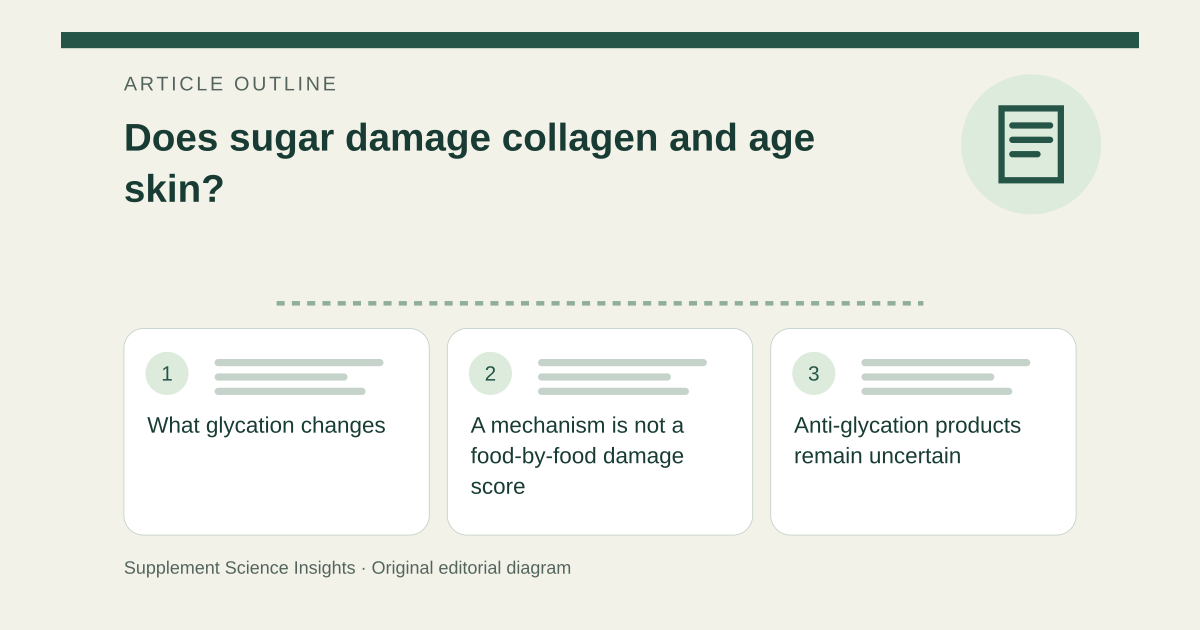
What glycation changes
Sugars and related reactive compounds can react with proteins to form advanced glycation end-products. The reviewed research describes collagen cross-linking, altered tissue properties and effects on cells involved in skin maintenance. Much of the intervention evidence comes from laboratory or animal models. [1]
A mechanism is not a food-by-food damage score
Experimental high-glucose exposure cannot calculate how much facial collagen is lost after a dessert. Skin aging reflects intrinsic change and external exposures as well as metabolic processes. The evidence does not support eliminating fruit or every carbohydrate as an anti-wrinkle treatment. [1][2]
Anti-glycation products remain uncertain
The review discusses numerous candidate agents, but formulations, models and measured outcomes vary. A lower glycation marker is not automatically visible rejuvenation or reversal of existing cross-links in a person. No universal supplement dose follows from these mechanistic findings. [1]
Use the information without overcorrecting
Imagine someone replaces all meals with an anti-glycation supplement routine. That does not address the evidence. A sustainable balanced diet and appropriate care for abnormal blood glucose are more sensible goals than trying to erase a single meal, while skin concerns deserve ordinary dermatologic assessment. [1][3]
| Claim | Interpretation |
|---|---|
| Protein cross-linking | Biological process |
| One dessert | No quantified collagen-loss prediction |
| Anti-glycation capsule | Not established wrinkle reversal |
Sources for this article
- Synthetic and Natural Agents Targeting Advanced Glycation End-Products for Skin Anti-Aging: A Comprehensive Review of Experimental and Clinical Studies - PMC
Source consulted: 2026-09-21. This is a reference resource, not a claim that we conducted the studies or tested a product. - Hyaluronic acid: A key molecule in skin aging - PMC
Source consulted: 2026-09-21. This is a reference resource, not a claim that we conducted the studies or tested a product. - Dietary Supplements: What You Need to Know - Consumer
Source consulted: 2026-09-21. This is a reference resource, not a claim that we conducted the studies or tested a product.