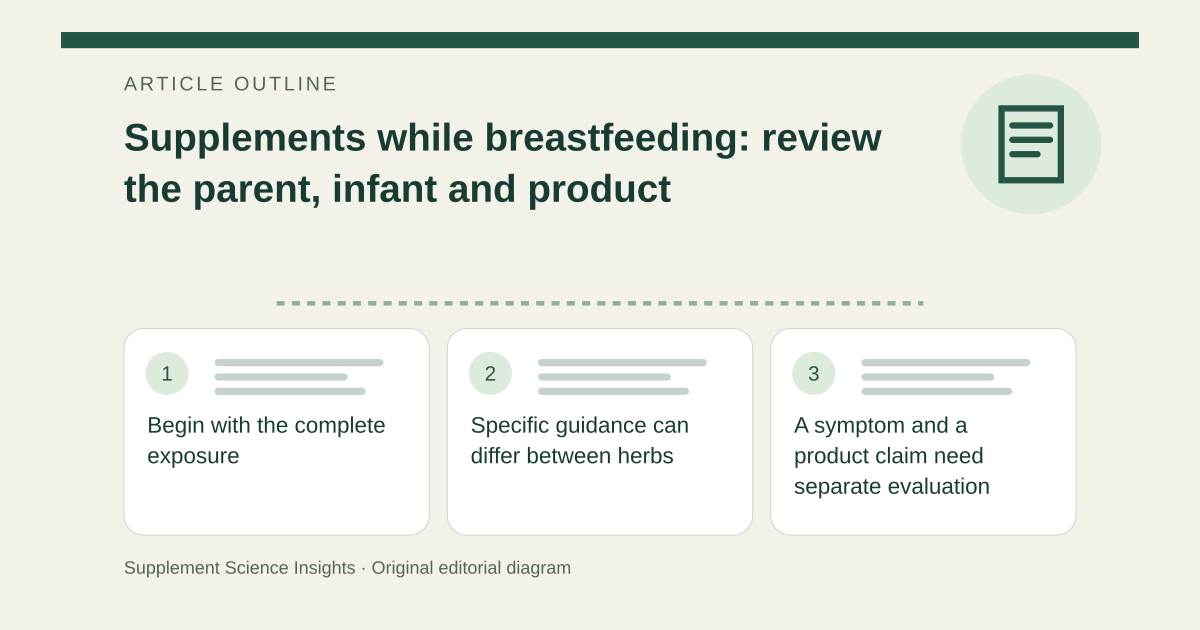
Begin with the complete exposure
Record the product, ingredients, amount, frequency and reason for use, together with medicines and other supplements. A familiar ingredient name can conceal a multi-ingredient extract or a substantially different concentration. ODS advises caution because many supplements have not been well tested in nursing women. [1]
The infant’s situation matters as well. A claim about a parent feeling better does not assess infant exposure or establish a feeding benefit. Maternal tolerability and infant safety should remain separate parts of the review. [1]
Specific guidance can differ between herbs
NCCIH advises against ashwagandha while breastfeeding. For fenugreek, it describes limited safety information and uncertain evidence for increasing milk supply. Those positions should not be collapsed into a claim that all herbs are equally safe or equally harmful. [2][3]
Nor does research involving a parent taking a product establish a dose for giving it directly to an infant. Route, recipient and formulation are essential details. Do not use a marketing phrase such as lactation support as a substitute for those data. [2][3]
A symptom and a product claim need separate evaluation
Imagine a parent starts an herbal blend because feeding seems inadequate. The product’s claim does not establish the cause of the problem or whether the infant is receiving enough milk. A feeding and growth assessment is more informative than escalating the blend’s dose.
| Situation | Interpretation |
|---|---|
| Parent tolerability | Not the same as infant safety |
| Lactation label | Not proof of benefit |
| Poor feeding concern | Needs assessment |
Sources for this article
- NIH ODS: Dietary Supplements — What You Need to Know
Source consulted: 2026-09-17. This is a reference resource, not a claim that we conducted the studies or tested a product. - NCCIH: Ashwagandha
Source consulted: 2026-09-17. This is a reference resource, not a claim that we conducted the studies or tested a product. - NCCIH: Fenugreek
Source consulted: 2026-09-17. This is a reference resource, not a claim that we conducted the studies or tested a product.