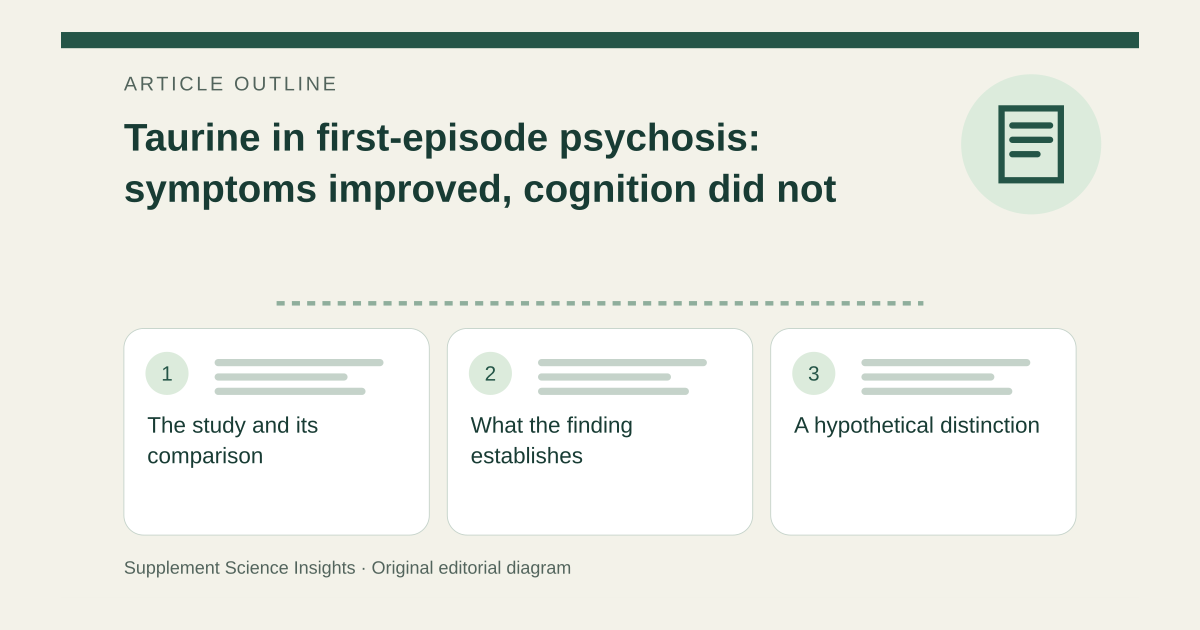
The study and its comparison
A twelve-week blinded adjunctive trial enrolled young adults with first-episode psychosis taking antipsychotic medication. Of 121 people who consented, 86 were included in the final analysis. [1]
Taurine favored the total psychiatric-symptom score and selected secondary measures. The coprimary composite cognitive score did not differ from placebo. The research regimen used four grams daily alongside existing treatment. [1]
What the finding establishes
The difference between consented and analyzed participants raises attrition concerns. A symptom-score signal is not proof of better cognition or a general dopamine-boosting effect. Funding and conflicts were not established from the abstract. This adjunctive study cannot justify replacing antipsychotic care, and a larger confirmatory trial would be needed to clarify the observed benefit. [1]
A hypothetical distinction
Imagine one coprimary outcome improves while the other does not. Calling both positive misrepresents the trial.
| Detail | Interpretation |
|---|---|
| Measured outcome | Keep the endpoint specific |
| Study preparation | Not every retail product |
| Remaining uncertainty | Not resolved by a mechanism |
Sources for this article
- Adjunctive Taurine in First-Episode Psychosis: A Phase 2, Double-Blind, Randomized, Placebo-Controlled Study.
Source consulted: 2026-09-19. This is a reference resource, not a claim that we conducted the studies or tested a product.