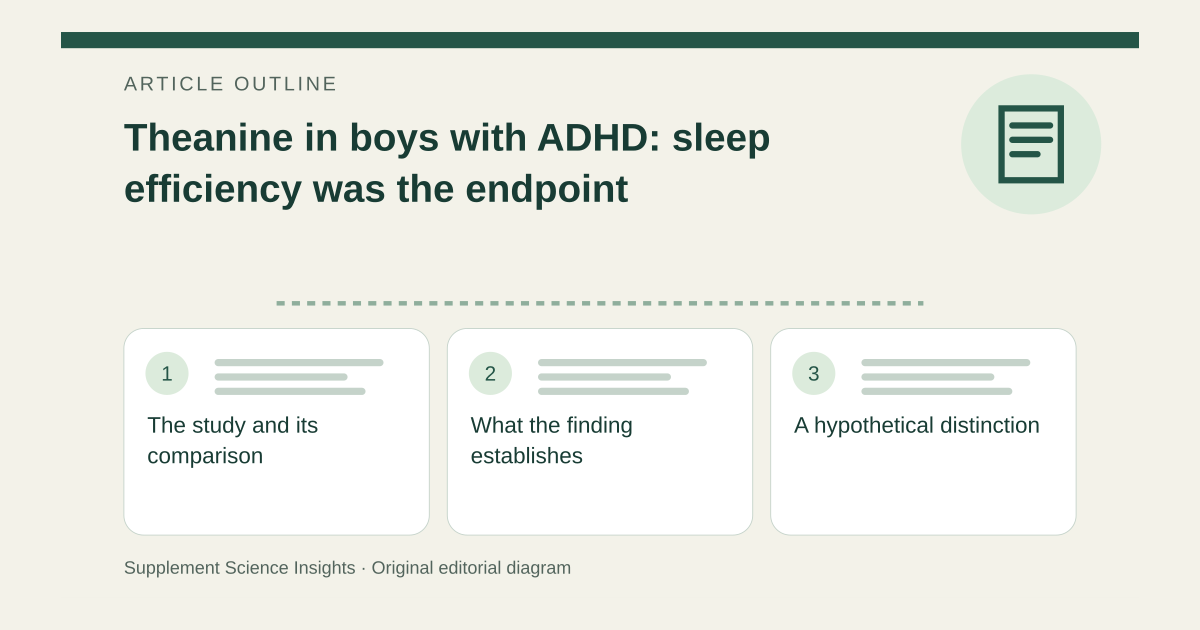
The study and its comparison
Ninety-eight boys aged 8–12 received theanine or placebo in a randomized trial. The active regimen was 400 milligrams daily, and wrist actigraphy recorded sleep at baseline and follow-up. [1]
Sleep percentage and efficiency favored theanine. Sleep latency and other parameters did not change, and parent questionnaire results did not closely match the objective measurements. [1]
What the finding establishes
A short trial in boys with a particular diagnosis does not establish indefinite safety for all children. The studied dose is not a general pediatric recommendation. Core daytime ADHD outcomes and long-term development require their own evidence. Funding and conflicts were not established from the abstract. [1]
A hypothetical distinction
Imagine sleep efficiency improves but attention in class is not measured. The unmeasured outcome cannot be assumed to improve too.
| Detail | Interpretation |
|---|---|
| Measured outcome | Keep the endpoint specific |
| Study preparation | Not every retail product |
| Remaining uncertainty | Not resolved by a mechanism |
Sources for this article
- The effects of L-theanine (Suntheanine®) on objective sleep quality in boys with attention deficit hyperactivity disorder (ADHD): a randomized, double-blind, placebo-controlled clinical trial - PubMed
Source consulted: 2026-09-19. This is a reference resource, not a claim that we conducted the studies or tested a product.