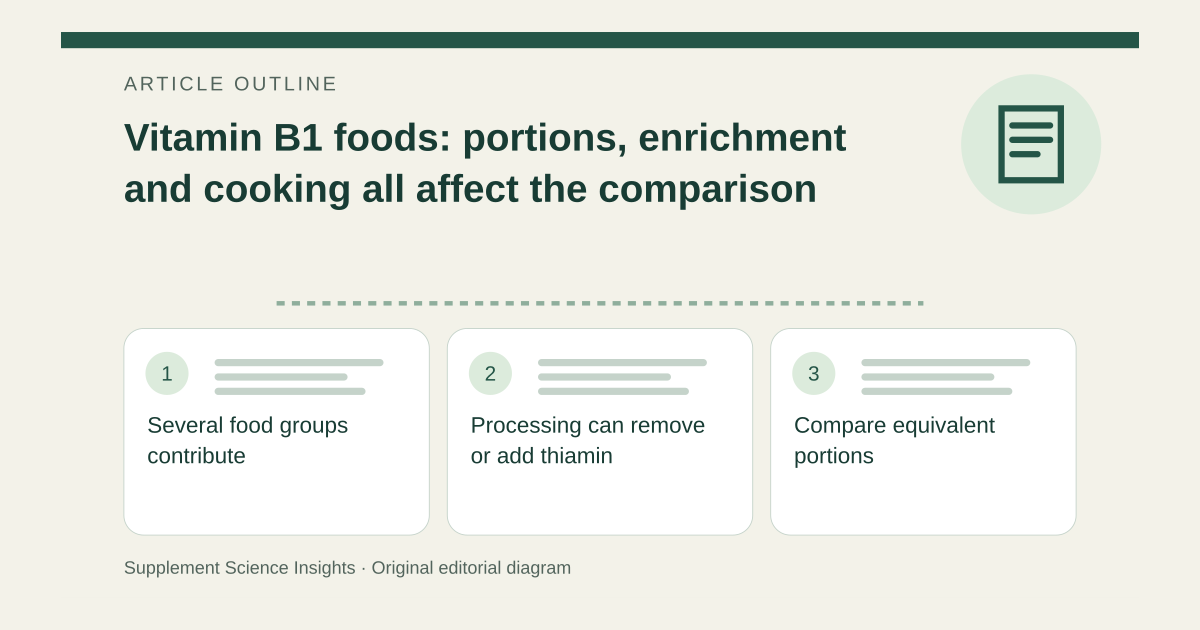
Several food groups contribute
ODS lists approximately 0.4 mg thiamin in a three-ounce broiled pork chop, three ounces of cooked trout or half a cup of boiled black beans. A cup of cooked enriched egg noodles supplies about 0.5 mg. These are specific serving estimates, not measurements of every product in the category. [1]
Fortified breakfast cereals can contribute substantially, but the listed example supplies 100 percent of the Daily Value by design. It should not be used as the value for any cereal without checking its label and serving size. [1]
Processing can remove or add thiamin
Heat can reduce thiamin content, and discarding cooking water can remove some because the vitamin dissolves in water. Grain processing also changes the content; enrichment adds thiamin back to some products. [1]
This does not make cooked food nutritionally worthless or establish one universally best source. Use a composition entry matching the food as eaten. A varied diet and realistic portions are more useful than applying a raw-food value to a cooked serving. [1]
Compare equivalent portions
Imagine one meal contains half a cup of the listed black beans and one cup of enriched egg noodles. Their estimated thiamin contribution is 0.4 plus 0.5, or 0.9 mg. Doubling the noodle portion would change the sum; the food name alone would not show that.
| Observation | What it establishes |
|---|---|
| Half-cup black beans | About 0.4 mg |
| Cup of enriched noodles | About 0.5 mg |
| Combined estimate | About 0.9 mg |
Sources for this article
- NIH ODS: Thiamin — Health Professional Fact Sheet
Source consulted: 2026-09-17. This is a reference resource, not a claim that we conducted the studies or tested a product.