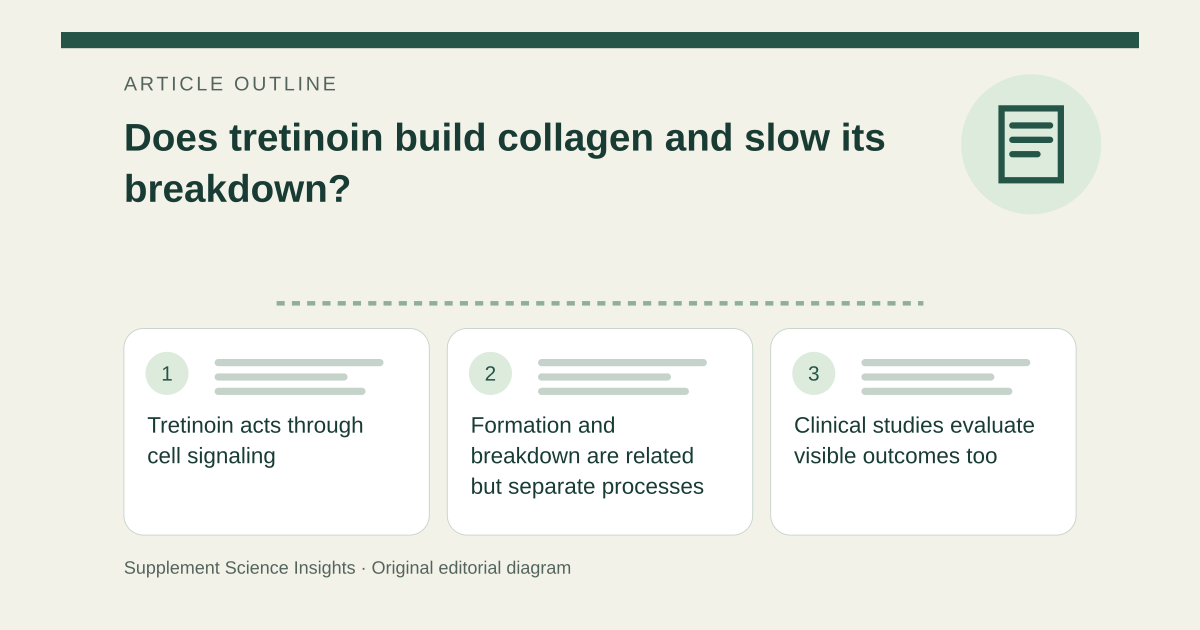
Tretinoin acts through cell signaling
Retinoid reviews describe changes in gene regulation and skin-cell behavior rather than a cream physically depositing collagen into the dermis. Tretinoin is already retinoic acid, while retinol requires conversion. A benefit observed with a particular tretinoin preparation cannot be assumed for every cosmetic vitamin A product. [1]
Formation and breakdown are related but separate processes
The review describes stimulation of collagen-related synthesis and inhibition of metalloproteinase activity involved in degradation. Those mechanisms help explain collagen remodeling. They should not be turned into a promise that all existing sun damage is reversed or that collagen continues increasing indefinitely. [1]
Clinical studies evaluate visible outcomes too
A systematic review of seven randomized trials reported improvements in features of photoaging, including wrinkles and uneven pigmentation. The studies varied in formulation, duration and outcome measures. Mechanistic evidence and a change in visible appearance support different parts of the explanation, rather than proving identical effects in every user. [2]
Tolerability and protection remain important
MedlinePlus notes that tretinoin does not eliminate wrinkles or completely repair sun damage. Irritation, dryness and peeling can occur, and using more than directed is not a reliable way to accelerate improvement. AAD advises sun protection and avoiding retinoids during pregnancy. [3][4]
Judge the change over an appropriate interval
Imagine fine lines improve gradually while deeper folds remain. That is compatible with a limited topical benefit, not evidence that the dose must keep rising. Review the treatment goal and tolerability with the clinician instead of interpreting every remaining wrinkle as failed collagen production. [3][2]
| Claim | Meaning |
|---|---|
| New collagen formation | A biological response, not collagen added by the cream |
| Reduced degradation pathways | One part of remodeling |
| Visible wrinkle improvement | A clinical outcome with limits |
| Higher concentration | Not automatically the best tolerated choice |
Sources for this article
- Use of Retinoids in Topical Antiaging Treatments: A Focused Review of Clinical Evidence for Conventional and Nanoformulations - PMC
Source consulted: 2026-09-21. This is a reference resource, not a claim that we conducted the studies or tested a product. - Topical tretinoin for treating photoaging: A systematic review of randomized controlled trials.
Source consulted: 2026-09-21. This is a reference resource, not a claim that we conducted the studies or tested a product. - Tretinoin Topical: MedlinePlus Drug Information
Source consulted: 2026-09-21. This is a reference resource, not a claim that we conducted the studies or tested a product. - Retinoid or retinol?
Source consulted: 2026-09-21. This is a reference resource, not a claim that we conducted the studies or tested a product.