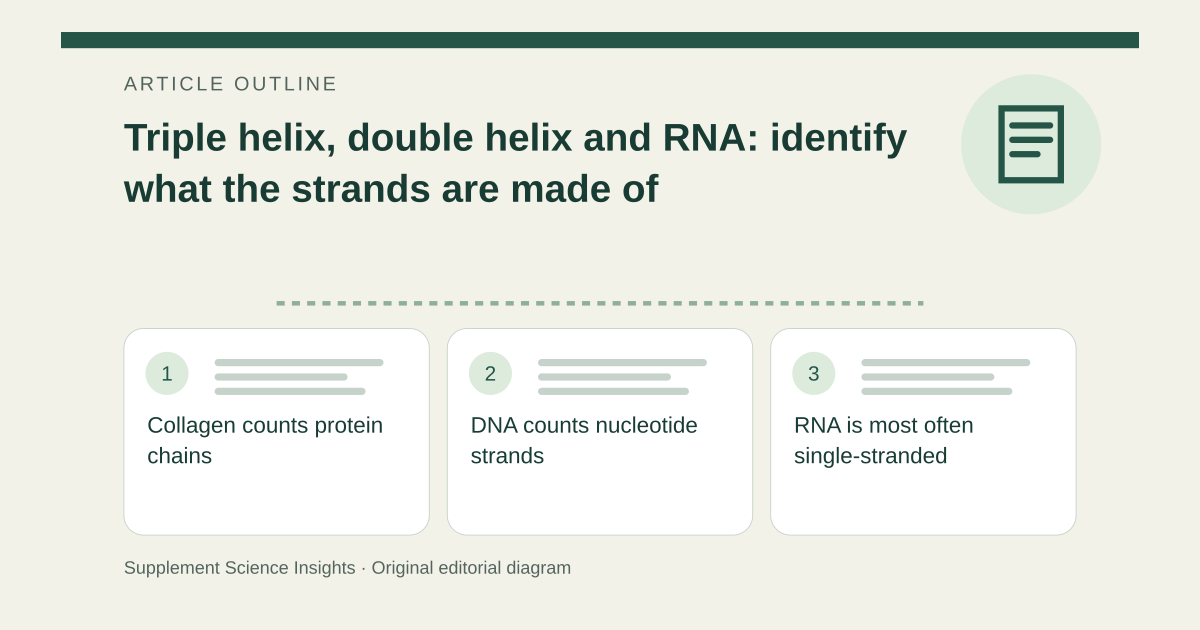
Collagen counts protein chains
MedlinePlus Genetics describes type I procollagen as two pro-alpha1(I) chains and one pro-alpha2(I) chain. The three protein chains form the characteristic arrangement before processing and assembly into larger collagen structures. Three chains does not mean a mixture of collagen types I, II and III. [1]
DNA counts nucleotide strands
NHGRI describes the familiar DNA structure as two linked strands wound together. Each has a sugar-phosphate backbone with bases whose sequence carries biological information. A DNA helix is therefore chemically different from collagen even when both are drawn as coils. [2]
RNA is most often single-stranded
RNA also uses a sugar-phosphate backbone, but its sugar is ribose and its bases include uracil. NHGRI distinguishes messenger, ribosomal and transfer RNA among its functional types. Single-stranded describes the usual strand arrangement; it does not mean RNA has no three-dimensional organization. [3]
A descriptive shape does not identify a nutrient product
Helix terminology must be read with the molecule and structural level. These basic comparisons are not an exhaustive catalog of all specialized nucleic-acid structures. They also cannot establish that a supplement labeled triple collagen is an intact molecular helix or produces a special clinical benefit. [1][2][3]
Label the counting unit in a diagram
Imagine a student labels three colored collagen chains as three DNA strands. Correct both the material and the count: the collagen model represents protein chains, while the usual DNA model represents two nucleotide strands. The same visual device can depict different chemistry. [1][2]
| Molecule | Material and usual description |
|---|---|
| Type I collagen | Three protein chains in a triple helix |
| DNA | Two nucleotide strands in a double helix |
| RNA | Most often one nucleotide strand |
Sources for this article
- COL1A1 gene: MedlinePlus Genetics
Source consulted: 2026-09-21. This is a reference resource, not a claim that we conducted the studies or tested a product. - Deoxyribonucleic Acid (DNA)
Source consulted: 2026-09-21. This is a reference resource, not a claim that we conducted the studies or tested a product. - Ribonucleic Acid (RNA)
Source consulted: 2026-09-21. This is a reference resource, not a claim that we conducted the studies or tested a product.