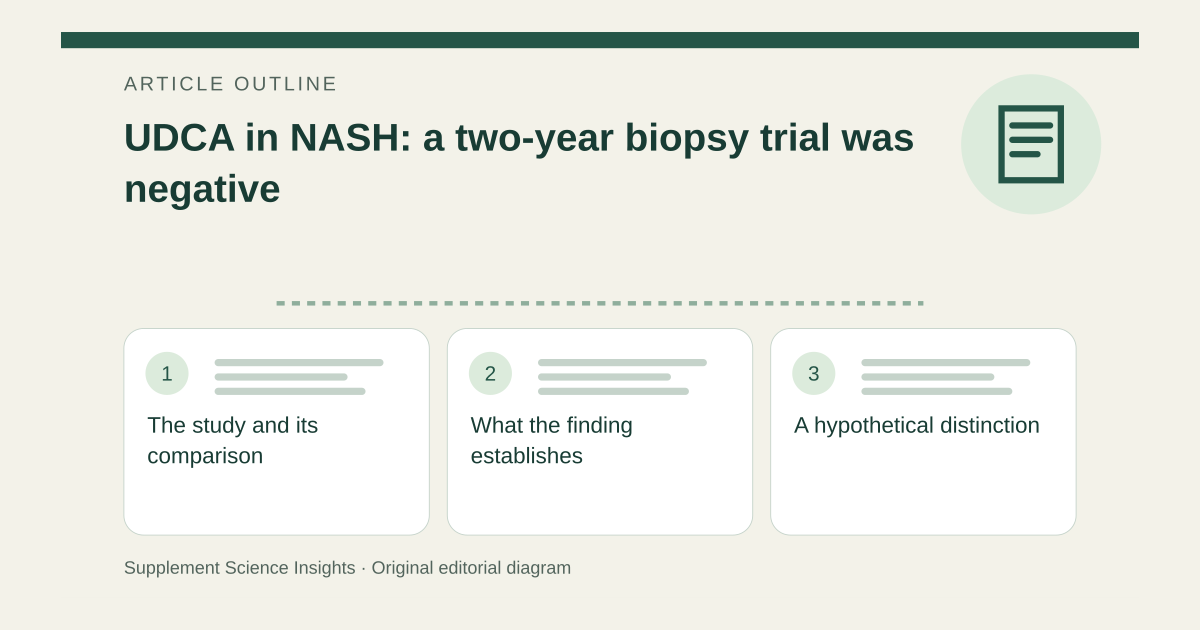
The study and its comparison
A 2004 trial randomized 166 people with biopsy-confirmed nonalcoholic steatohepatitis to ursodeoxycholic acid or placebo. Treatment lasted two years; 126 completed treatment and 107 had paired biopsies. [1]
Changes in fat accumulation, inflammation and fibrosis did not significantly differ between groups. Liver blood tests were stable or improved in both groups, so those changes could not be assigned specifically to UDCA. [1]
What the finding establishes
The trial concerns a defined liver disease and regimen, not every indication for this medicine or every bile-acid product. Incomplete paired biopsies also limit interpretation. Funding and conflicts were not established from the abstract. Historical statements about available treatments should not be read as current guidance, and the study does not establish UDCA as a routine dietary supplement. [1]
A hypothetical distinction
Imagine blood tests improve equally with treatment and placebo. The treatment comparison remains negative despite the before-and-after improvement.
| Detail | Interpretation |
|---|---|
| Measured outcome | Keep the endpoint specific |
| Study preparation | Not every retail product |
| Remaining uncertainty | Not resolved by a mechanism |
Sources for this article
- Ursodeoxycholic acid for treatment of nonalcoholic steatohepatitis: results of a randomized trial.
Source consulted: 2026-09-19. This is a reference resource, not a claim that we conducted the studies or tested a product.