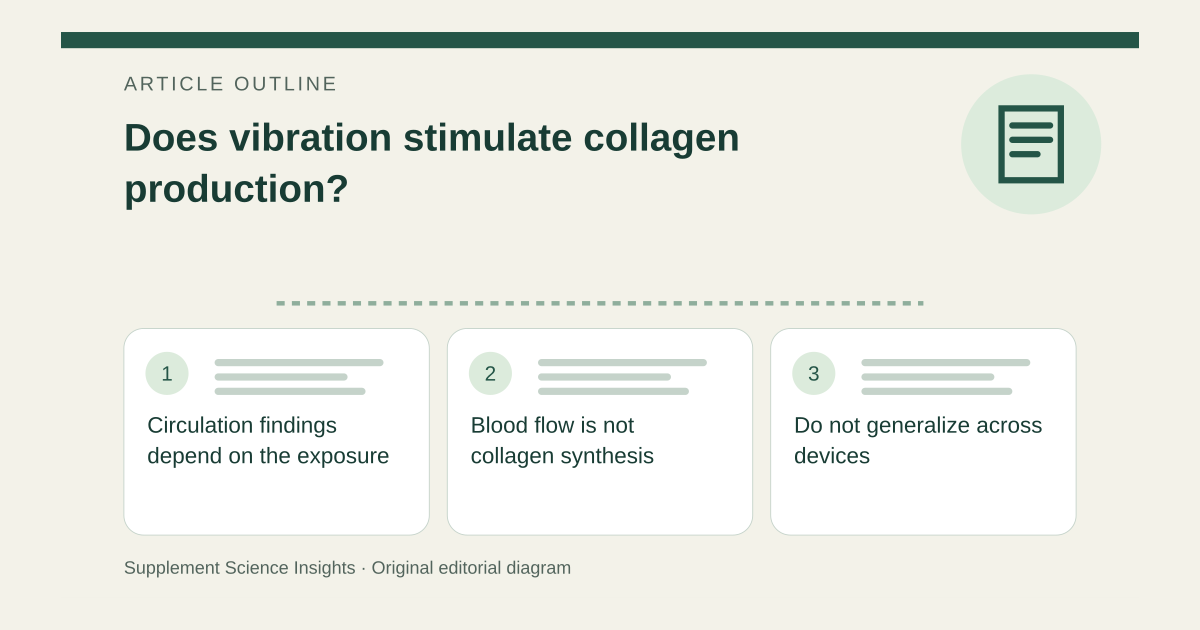
Circulation findings depend on the exposure
A 2026 scoping review of human studies found that vibration changed skin blood flow differently across settings. Lower-extremity applications often increased flow, while occupational hand vibration commonly decreased it. Frequency, location and duration mattered. [1]
Blood flow is not collagen synthesis
The review’s endpoint was skin circulation. It does not show that increased flow creates enough new collagen to reduce wrinkles or tighten skin. A device marketed using a blood-flow study still needs evidence for its actual cosmetic claim. [1]
Do not generalize across devices
A whole-body platform, handheld facial massager and occupational tool create different exposures. A stronger vibration is not necessarily more beneficial. Follow the device instructions and assess suitability for your health situation rather than copying settings from unrelated research. [1]
Look for the missing clinical link
Imagine an advertisement jumps from improved circulation to rebuilt facial collagen. Ask whether a controlled study measured collagen or a durable cosmetic outcome with that same device. Without that link, the advertised mechanism remains insufficient evidence for the promised result. [1]
| Claim | Interpretation |
|---|---|
| Blood-flow change | Context-dependent physiology |
| Collagen increase | Different endpoint |
| Facial tightening | Needs relevant clinical evidence |
Sources for this article
- Impact of Vibration on Skin Blood Flow: A Scoping Review.
Source consulted: 2026-09-21. This is a reference resource, not a claim that we conducted the studies or tested a product.