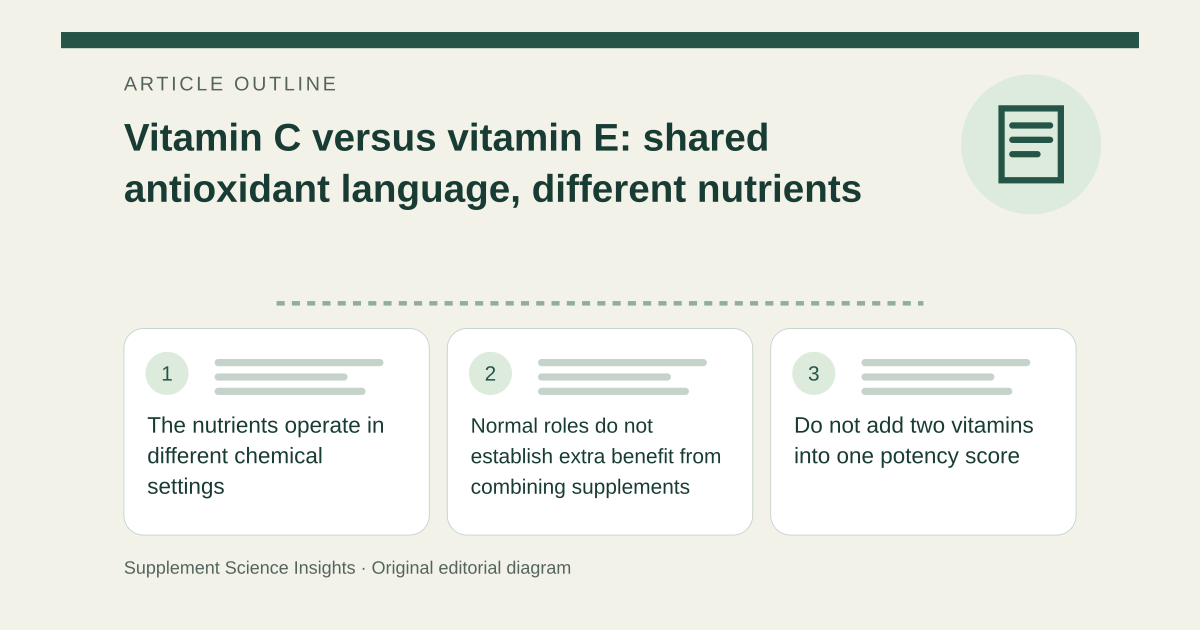
The nutrients operate in different chemical settings
ODS describes vitamin C as a water-soluble vitamin and vitamin E as a group of fat-soluble compounds. Vitamin E’s antioxidant role is particularly relevant to fats and cell structures containing them. [1][2]
Vitamin C also participates in antioxidant processes, but it has other roles, including collagen synthesis. A shared antioxidant description does not make the vitamins interchangeable. [1][2]
Normal roles do not establish extra benefit from combining supplements
Adequate intake is necessary for normal physiology. That fact does not show that adding high amounts of both vitamins prevents disease or improves every outcome associated with oxidative stress. [1][2]
A clinical claim needs the actual formulation, participants and outcome. Mechanistic complementarity is a reason to study a combination, not the completed proof that the combination helps a particular person. [1][2]
Do not add two vitamins into one potency score
Imagine one label provides vitamin C in milligrams and another provides vitamin E in milligrams. Their masses can be recorded, but adding them does not create a meaningful antioxidant-strength number.
The nutrients have different requirements and effects. A larger printed amount of one is not evidence that it replaces the other.
| Detail | Interpretation |
|---|---|
| Vitamin C amount | Record as vitamin C |
| Vitamin E amount | Record separately |
| Combined antioxidant potency | Not established by adding their masses |
Different nutrients bring different excess-intake concerns
Large vitamin C intakes can cause gastrointestinal effects and need particular caution in some kidney or iron-overload settings. High supplemental vitamin E can increase bleeding-related concerns, especially alongside relevant medicines. [1][2]
Neither water solubility nor fat solubility alone supplies a personal safety decision. This comparison explains the distinction without recommending a combined regimen. [1][2]
Sources for this article
- NIH ODS: Vitamin C
Source consulted: 2026-09-17. This is a reference resource, not a claim that we conducted the studies or tested a product. - NIH ODS: Vitamin E
Source consulted: 2026-09-17. This is a reference resource, not a claim that we conducted the studies or tested a product.