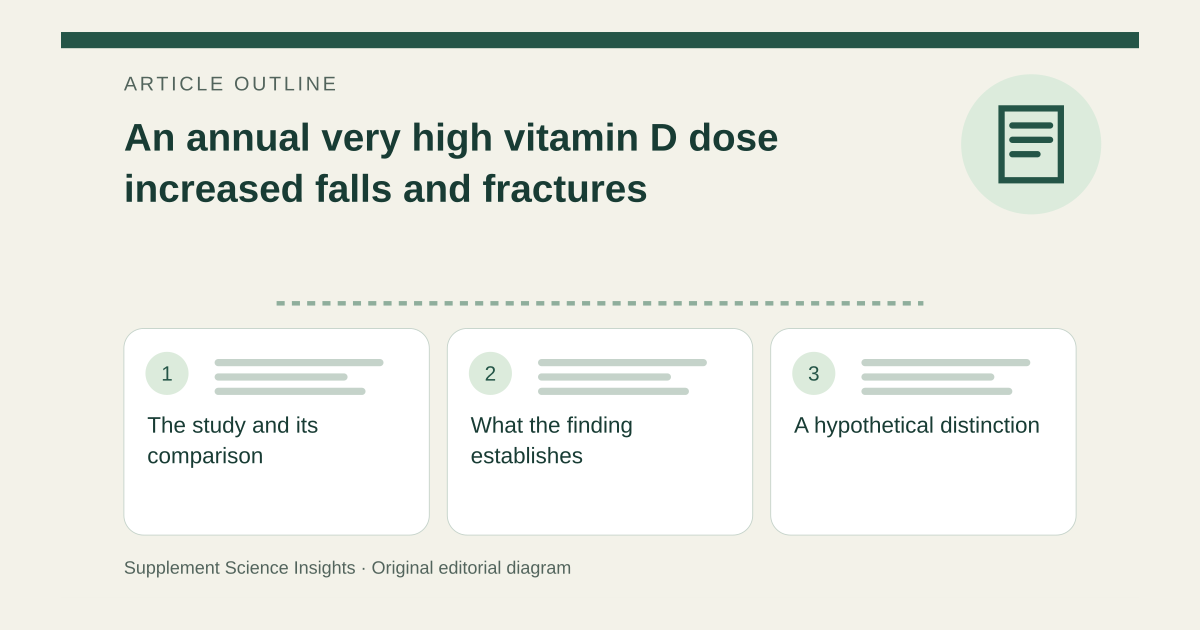
The study and its comparison
A blinded trial randomized 2,256 community-dwelling women aged seventy or older to 500,000 IU vitamin D or placebo once a year for three to five years. Falls were recorded monthly and fractures confirmed radiologically. [1][2]
Fall rates were about fifteen percent higher and fracture rates twenty-six percent higher with vitamin D. A subsequent correction clarified the denominators for women who fell: 1,131 in the vitamin group and 1,125 in the placebo group. [1][2]
What the finding establishes
This annual very high dose is not interchangeable with routine intake or a clinician-managed deficiency regimen. The trial illustrates why convenience and higher blood levels cannot substitute for clinical safety outcomes. Funding and conflicts were not established from the abstract. The published denominator correction is included with the source record. [1][2]
A hypothetical distinction
Imagine taking a year’s amount at once seems convenient. Outcomes can differ from spreading intake over time.
| Detail | Interpretation |
|---|---|
| Measured outcome | Keep the endpoint specific |
| Study preparation | Not every retail product |
| Remaining uncertainty | Not resolved by a mechanism |
Sources for this article
- Annual high-dose oral vitamin D and falls and fractures in older women: a randomized controlled trial.
Source consulted: 2026-09-19. This is a reference resource, not a claim that we conducted the studies or tested a product. - Correction: annual high-dose vitamin D trial falls denominators
Source consulted: 2026-09-19. This is a reference resource, not a claim that we conducted the studies or tested a product.