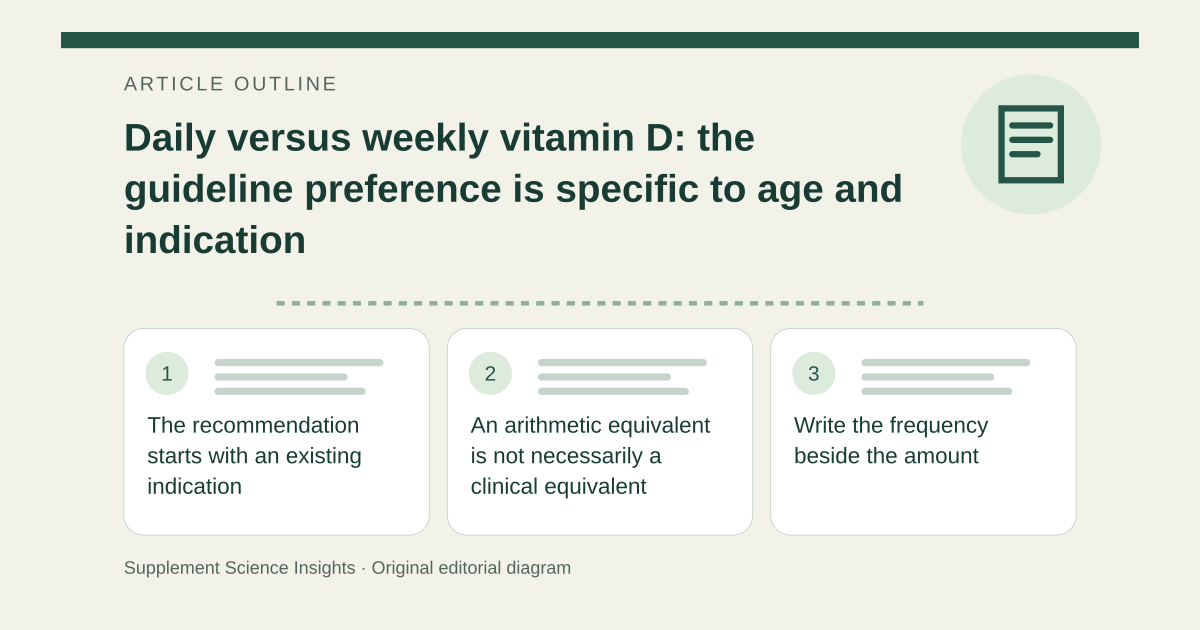
The recommendation starts with an existing indication
The guideline addresses nonpregnant adults aged 50 years and older who already have an indication for vitamin D supplementation or treatment. It conditionally favors daily lower-dose use over non-daily higher-dose schedules. It is not a recommendation that everyone over 50 start a supplement. [1]
The panel did not identify evidence addressing this comparison in people younger than 50. Lack of evidence for that group is not proof that either schedule is superior, and it should remain visible when discussing the recommendation. [1]
An arithmetic equivalent is not necessarily a clinical equivalent
Dividing a weekly amount by seven gives an average daily amount, but it does not establish that two regimens have identical effects or are appropriate for the same indication. A prescribed course can have a specific duration, monitoring plan and clinical reason. [1]
Ask the prescriber or pharmacist about the intended schedule rather than changing a high-dose product into a daily one. Product concentration and dosing frequency both matter. This page supplies no loading regimen or instruction to override a prescribed course. [1]
Write the frequency beside the amount
Imagine a label states an amount intended once weekly, but only the number is copied into a daily checklist. That omits the essential frequency instruction. Recording amount, interval and duration together avoids a different regimen being mistaken for the original.
| Observation | What it establishes |
|---|---|
| Amount alone | Incomplete regimen |
| Amount plus frequency | Defines repeated exposure |
| Change of schedule | Requires clinical review |
Sources for this article
- Endocrine Society: Vitamin D for the Prevention of Disease
Source consulted: 2026-09-17. This is a reference resource, not a claim that we conducted the studies or tested a product.