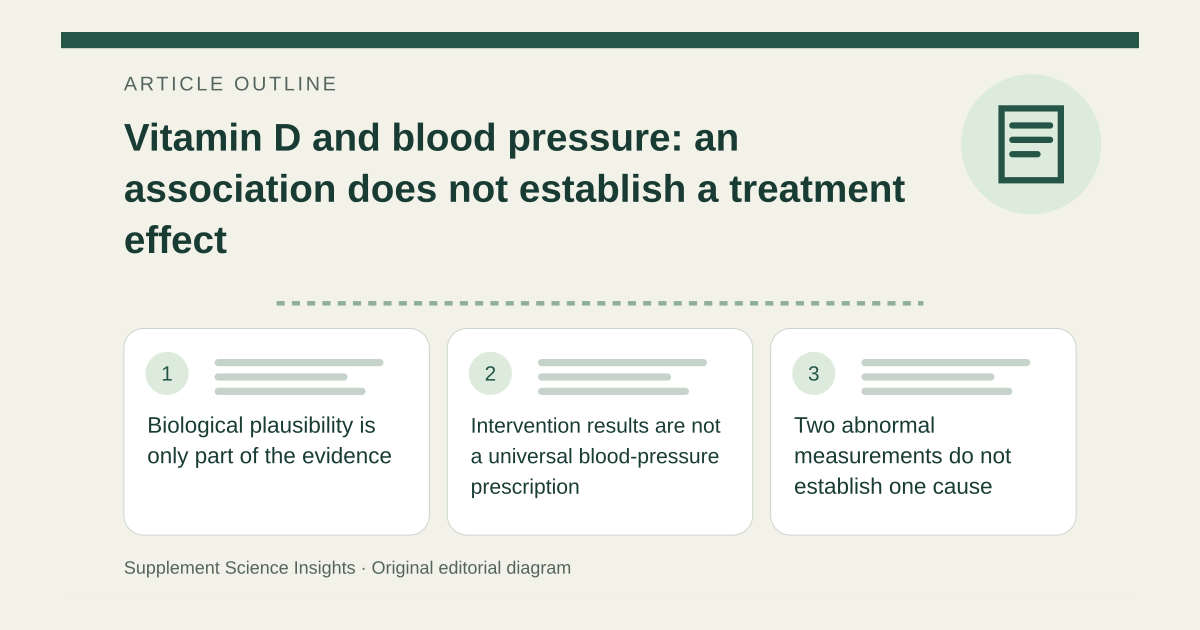
Biological plausibility is only part of the evidence
Vitamin D participates in pathways involved in blood-pressure regulation, and observational studies link lower status with some cardiovascular problems. ODS distinguishes those associations from the question of whether giving vitamin D improves an outcome. [1]
People with low vitamin D may differ in health, activity and other factors. An association does not show that deficiency is the sole cause of hypertension, or that raising the blood concentration will reliably correct it. [1]
Intervention results are not a universal blood-pressure prescription
ODS describes mixed blood-pressure findings across trial syntheses, with some subgroup effects and other analyses finding no reduction. Trials differ in baseline status, participants, amount, schedule and use of calcium. Selecting only the favorable subgroup would overstate the consistency. [1]
Broader trials have not established routine vitamin D supplementation as cardiovascular prevention. Correcting a clinically identified deficiency can still be appropriate, but that is separate from replacing blood-pressure treatment. Review the actual readings, medicines and vitamin D indication with the clinician. [1]
Two abnormal measurements do not establish one cause
Imagine someone has both low vitamin D and elevated blood pressure. The co-occurrence makes both worth assessing. It does not prove that treating the vitamin result alone will resolve hypertension or remove the need for follow-up.
| Observation | What it establishes |
|---|---|
| Low vitamin D plus hypertension | Coexisting findings |
| Causal explanation | Not established by coexistence |
| Blood-pressure response | Needs direct monitoring |
Sources for this article
- NIH ODS: Vitamin D — Health Professional Fact Sheet
Source consulted: 2026-09-17. This is a reference resource, not a claim that we conducted the studies or tested a product.