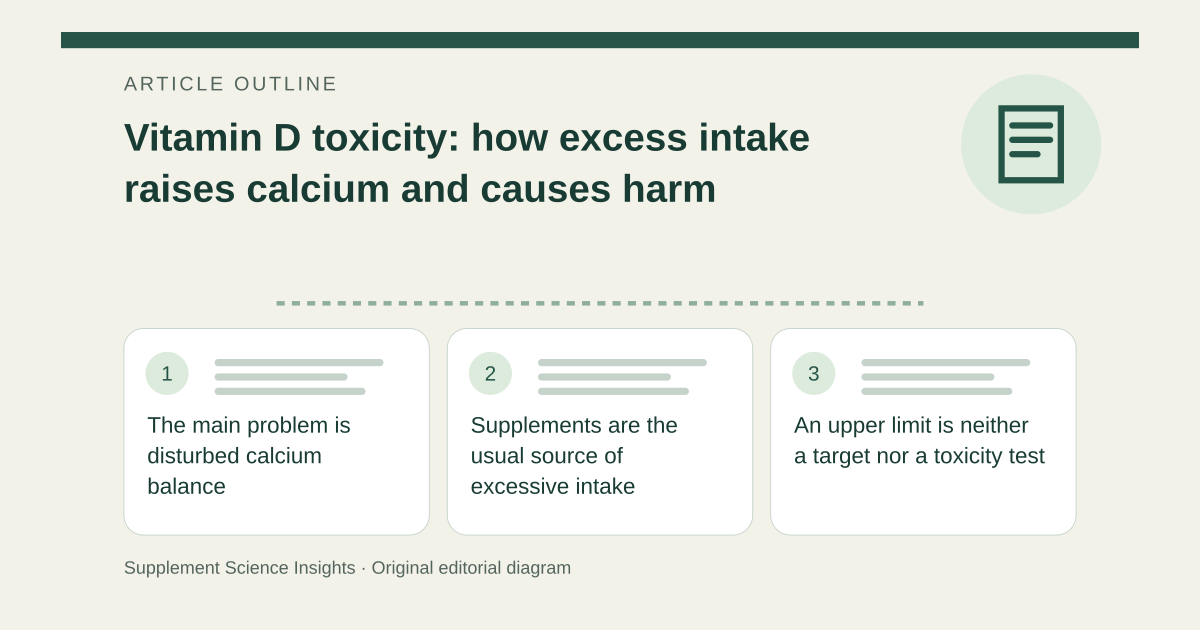
The main problem is disturbed calcium balance
Vitamin D helps the intestine absorb calcium. Excessive intake can push this system too far, producing high blood calcium and high urine calcium. NIH ODS describes nausea, vomiting, weakness, thirst, frequent urination and dehydration among possible consequences; severe toxicity can damage kidneys and other tissues. [1]
These symptoms have other possible causes, so they do not diagnose toxicity by themselves. They are a reason to seek assessment when they occur with a possible excessive intake, rather than continuing a high-dose experiment. [1]
Supplements are the usual source of excessive intake
ODS states that vitamin D toxicity is almost always related to excessive supplement intake. It describes inappropriate use, manufacturing errors and prescribing errors among reported causes. Multiple products can also make the actual total harder to recognize. [1]
The amount per drop, per milliliter or per serving must stay attached to the number. Two liquid products with similar packaging need not have the same concentration. A dose volume from one bottle should not be transferred to another without checking the instructions. [1]
An upper limit is neither a target nor a toxicity test
The U.S. adult tolerable upper intake level is 100 micrograms, or 4,000 IU, daily; lower limits apply to younger children. The upper limit describes a usual-intake safety framework. It does not mean toxicity begins precisely at that number or that taking the limit is desirable. [1]
Clinicians sometimes prescribe regimens outside ordinary intake guidance for specific reasons. That does not justify copying a treatment schedule without its indication and monitoring, or changing a prescribed regimen solely from a general reference table. [1]
Make overlap visible before doing arithmetic
Imagine a hypothetical multivitamin supplies 1,000 IU and a separate product supplies 2,000 IU at the amounts recorded as used. Together those entries are 3,000 IU, equivalent to 75 micrograms. The example does not recommend that intake and leaves out any undocumented food or product sources.
If a third bottle has unclear serving directions, mark it unresolved instead of guessing. The safety of the total cannot be decided from a partial arithmetic exercise.
| Observation | Meaning |
|---|---|
| 1,000 IU plus 2,000 IU | 3,000 IU total from those entries |
| 3,000 IU divided by 40 | 75 micrograms |
| Unknown third serving | Total remains incomplete |
Suspected overdose needs prompt advice
If excessive use is suspected, seek medical or poison-control advice promptly and keep the packages available. Do not attempt to treat suspected hypercalcemia by improvising a fluid, mineral or medication regimen. Kidney disease and medicines such as thiazide diuretics can further complicate calcium balance. [1]
No product is selected here: the useful outcome is recognizing an exposure and obtaining appropriate assessment, not finding a more potent formulation. [1]
Sources for this article
- NIH ODS — Vitamin D: Health Professional Fact Sheet
Source consulted: 2026-09-17. This is a reference resource, not a claim that we conducted the studies or tested a product.