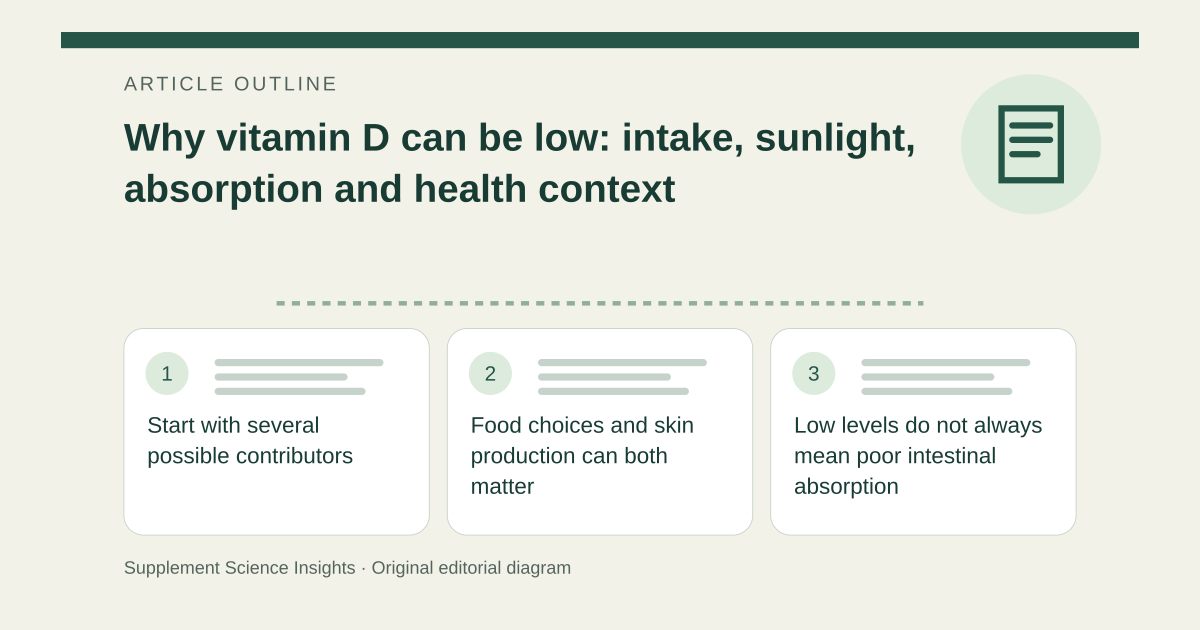
Start with several possible contributors
Vitamin D status reflects more than supplement use. Limited dietary intake, limited skin production, difficulty absorbing fat-soluble nutrients and impaired activation can all contribute to vitamin D-related problems. More than one factor can be present at the same time. [1]
A low 25-hydroxyvitamin D result is therefore not a diagnosis of one behavior, such as “not enough time outdoors.” Nor does it prove that a particular supplement brand has failed. The result needs its clinical and exposure history. [1]
Food choices and skin production can both matter
Few foods naturally supply much vitamin D, so fortified foods can be important. Avoiding a food group is relevant only in the context of what replaces it: a person who avoids dairy may still use an appropriately fortified alternative. [1]
Limited outdoor exposure, clothing coverage, season and age-related changes in skin synthesis can reduce the contribution from sunlight. Skin pigmentation affects production, but skin color alone does not establish a person’s vitamin D status or the need for treatment. [1]
Low levels do not always mean poor intestinal absorption
Conditions that impair fat absorption and some gastrointestinal operations can reduce uptake. Certain medicines also affect vitamin D absorption or metabolism. Kidney disease introduces an additional issue because the kidneys participate in activation and mineral regulation. [1]
People with obesity often have lower circulating 25(OH)D, but ODS distinguishes this from a reduced ability to absorb vitamin D through the gut. The mechanism matters when interpreting why a result is low. [1]
A cause review is more useful than one assumption
Imagine a person has a low result after months of using a supplement. The review might check what amount was actually taken, missed doses, the timing of the test, gastrointestinal history and relevant medicines. “The product does not absorb” is only one possible explanation and cannot be concluded from that result alone.
| Observation | Meaning |
|---|---|
| Actual supplement use | Different from the printed serving recommendation |
| Surgery or digestive disease | May change absorption |
| Medicines and kidney history | May change handling or the treatment plan |
Do not turn risk-factor lists into universal screening rules
The Endocrine Society suggests against routine screening of otherwise healthy adults, including routine screening based solely on obesity or dark complexion. Those recommendations do not apply to every established medical indication for testing. [2][1]
Use a clinician’s assessment to decide whether testing or replacement is needed. Increasing intake repeatedly or deliberately increasing UV exposure is not a substitute for understanding the clinical question. [2][1]
Sources for this article
- NIH ODS — Vitamin D: Health Professional Fact Sheet
Source consulted: 2026-09-17. This is a reference resource, not a claim that we conducted the studies or tested a product. - Endocrine Society — Vitamin D for the Prevention of Disease
Source consulted: 2026-09-17. This is a reference resource, not a claim that we conducted the studies or tested a product.