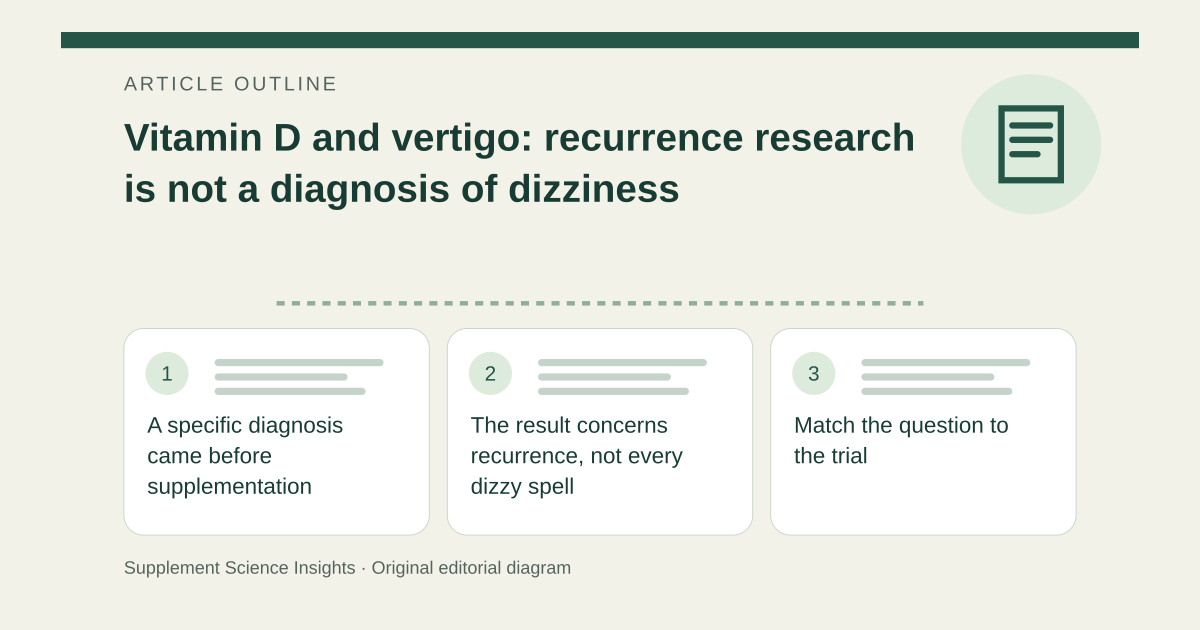
A specific diagnosis came before supplementation
The study assigned 1,050 people with confirmed benign paroxysmal positional vertigo, or BPPV, to an intervention or observation group. All had first been successfully treated with canalith repositioning maneuvers. [1]
In the intervention group, people whose vitamin D was below 20 ng/mL received vitamin D with calcium for a year. The observation group had follow-up without that assessment-and-supplementation strategy. Outcome assessors were blinded, but this was not a matching-placebo trial. [1]
The result concerns recurrence, not every dizzy spell
Annual recurrence was lower in the intervention group: 0.83 versus 1.10 episodes per person-year. The proportions with any recurrence were 37.8% and 46.7%. These are different measures and should not be interchanged. [1]
Because the strategy included calcium and targeted low vitamin D, it does not isolate vitamin D alone. It also cannot show that a new episode of nonspecific dizziness is caused by deficiency or can replace assessment and repositioning care. [1]
Match the question to the trial
Imagine someone has dizziness but no established BPPV diagnosis. A trial preventing recurrence after BPPV treatment does not establish the cause of that first presentation.
| Detail | Interpretation |
|---|---|
| Confirmed BPPV | Entry condition |
| Vitamin D plus calcium | Combined intervention |
| Recurrence | Not initial symptom diagnosis |
Sources for this article
- Prevention of benign paroxysmal positional vertigo with vitamin D supplementation: A randomized trial - PubMed
Source consulted: 2026-09-19. This is a reference resource, not a claim that we conducted the studies or tested a product.