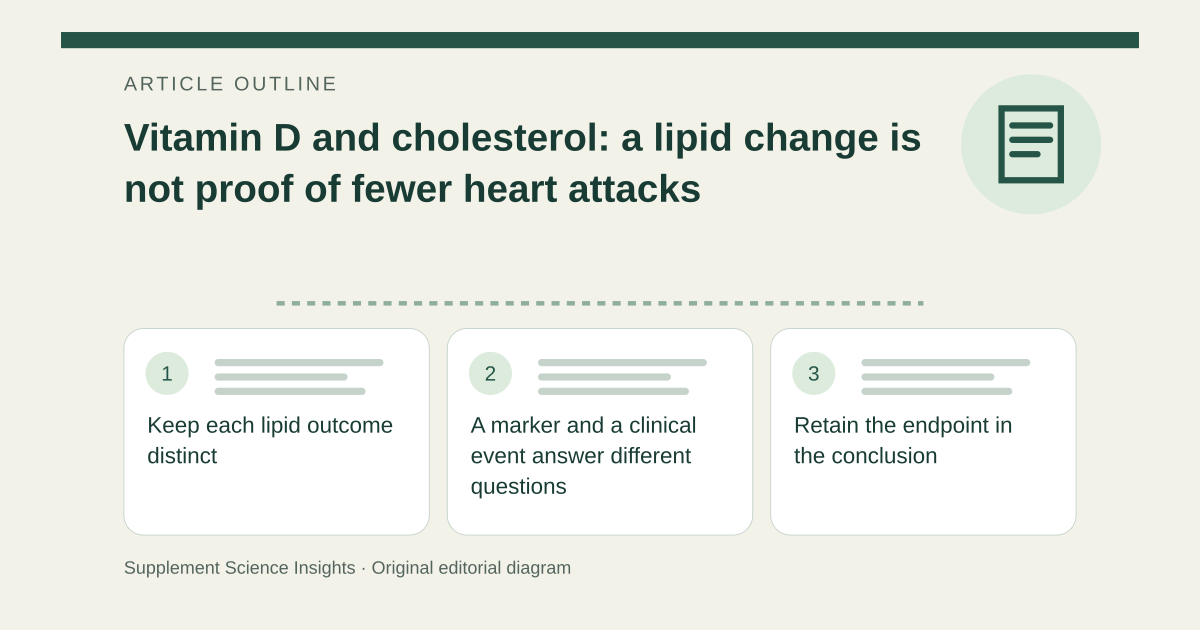
Keep each lipid outcome distinct
The ODS review describes mixed evidence on supplemental vitamin D and cholesterol. One synthesis of 41 trials reported reductions in total cholesterol, LDL cholesterol and triglycerides, but not an improvement in HDL. Trial amounts, durations and participant characteristics varied widely. [1]
A pooled change is not a guarantee that a particular person’s result will move in the same direction. It also does not identify a retail product, personal dose or ideal blood vitamin D target for cholesterol management. [1]
A marker and a clinical event answer different questions
Large vitamin D trials have generally not demonstrated fewer major cardiovascular events. It is therefore misleading to turn a favorable lipid-marker result into a promise of fewer heart attacks or strokes. The clinical outcome requires direct evidence. [1]
Vitamin D assessment or deficiency treatment may have a separate indication. It should not be used to replace prescribed lipid-lowering treatment based on a nutrient association. The relevant discussion considers overall cardiovascular risk and established care, not one marker in isolation. [1]
Retain the endpoint in the conclusion
Imagine a study reports a modest LDL change but does not track heart attacks. Describing it as demonstrating heart-attack prevention would add an outcome it did not measure. Even a statistically clear marker change does not supply that missing result.
| Observation | What it establishes |
|---|---|
| LDL concentration | A lipid marker |
| Heart attacks | Clinical events |
| One implies the other | Requires additional evidence |
Sources for this article
- NIH ODS: Vitamin D — Health Professional Fact Sheet
Source consulted: 2026-09-17. This is a reference resource, not a claim that we conducted the studies or tested a product.