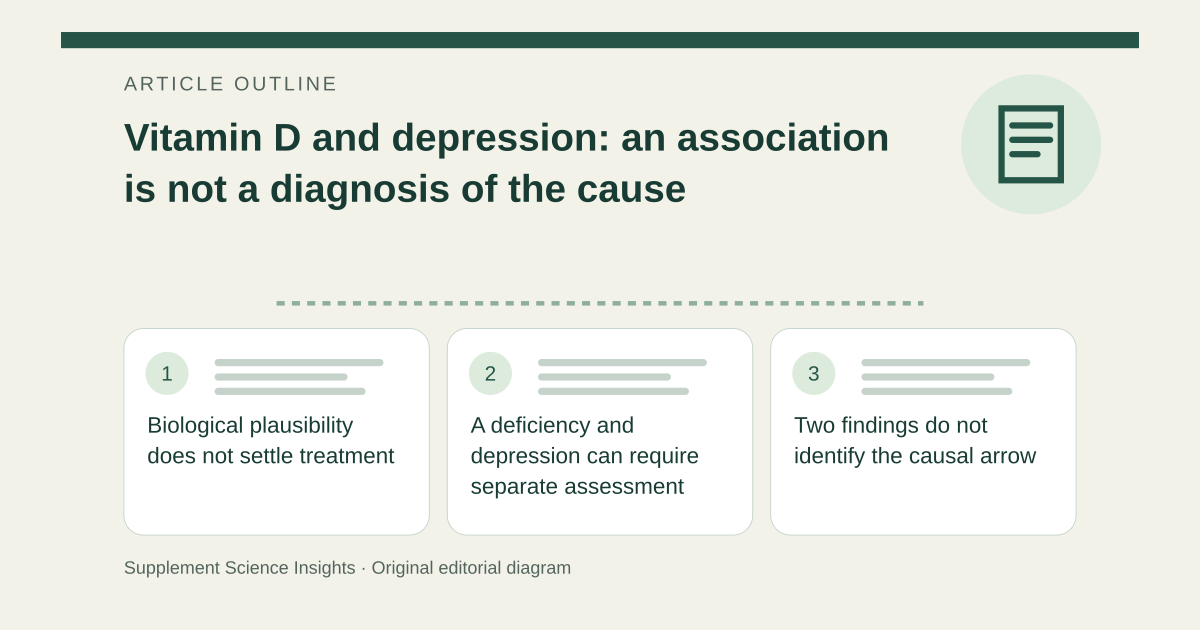
Biological plausibility does not settle treatment
Vitamin D receptors occur in brain cells, and observational studies have linked lower vitamin D levels with depression. Those findings motivate research; they do not establish that a low result explains an individual’s mood symptoms. [1]
ODS distinguishes these associations from randomized trials, which generally have not demonstrated prevention or treatment of depressive symptoms with supplementation. The source describes differing populations, baseline levels and treatment settings, which limit universal conclusions. [1]
A deficiency and depression can require separate assessment
The ODS discussion particularly addresses studies in middle-aged and older adults and notes gaps in certain clinical populations. It should not be read as proof that every possible subgroup has been definitively tested. [1]
Equally, an unresolved subgroup question is not evidence of benefit. A low vitamin D result can be reviewed on its own merits while the clinician evaluates depression and appropriate care. This article does not establish a supplement dose, medication change or replacement for psychological treatment. [1]
Two findings do not identify the causal arrow
Imagine someone has both a low laboratory result and depressive symptoms. Correcting the laboratory abnormality and assessing the symptoms are both possible tasks. Improvement, persistence or fluctuation in mood cannot by itself prove that vitamin D was the original cause.
| Observation | Meaning |
|---|---|
| Low vitamin D result | A nutritional assessment |
| Depressive symptoms | A clinical mental-health assessment |
| Both present | Causation remains unproven |
Sources for this article
- NIH ODS: Vitamin D
Source consulted: 2026-09-17. This is a reference resource, not a claim that we conducted the studies or tested a product.