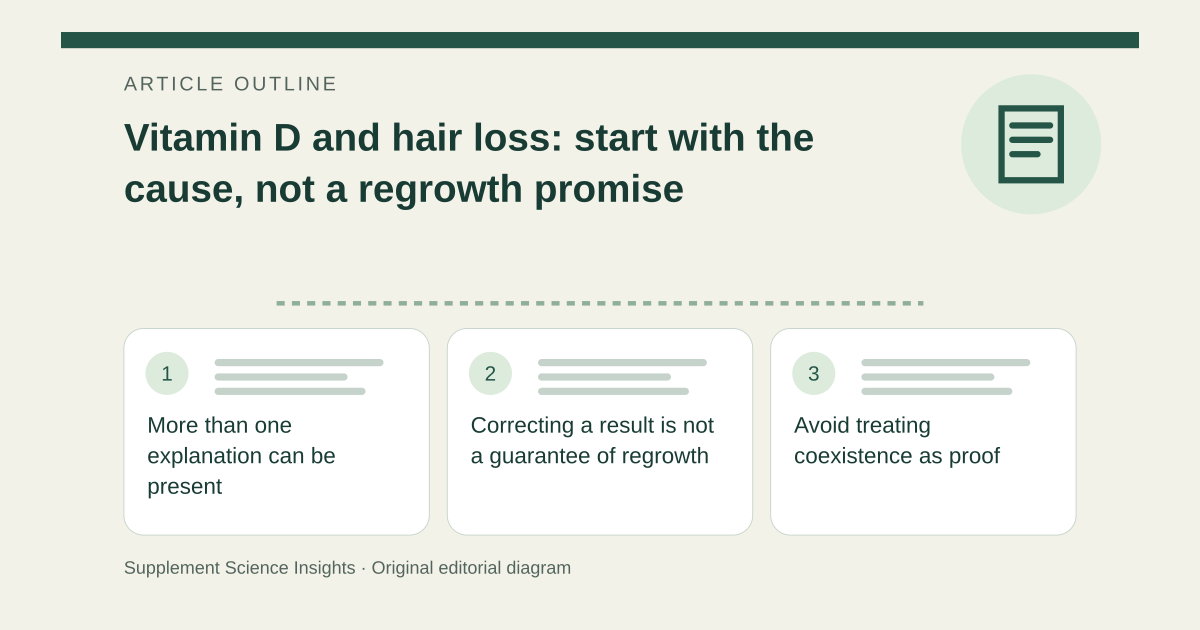
More than one explanation can be present
The American Academy of Dermatology describes examining the scalp and history, with blood tests or biopsy when a disease, nutrient deficiency, hormone problem or infection is suspected. Some people have more than one cause of hair loss at the same time. [1][2]
That framework does not allow the appearance of thinning hair to identify a specific vitamin deficiency. Vitamin D status is assessed separately, principally with a 25-hydroxyvitamin D blood measurement when clinically appropriate. [1][2]
Correcting a result is not a guarantee of regrowth
Treatment is chosen according to the cause of the hair loss. If low vitamin D and hereditary thinning coexist, an improved vitamin D result does not prove the hereditary component has been treated. [1][2]
These sources do not establish a vitamin D regrowth dose, a reliable regrowth deadline, or a method of applying the contents of oral capsules to the scalp. Increasing oral intake without regard to need can also create vitamin D toxicity. [1][2]
Avoid treating coexistence as proof
Imagine a person has a low vitamin D result and hair shedding after a major illness. Both findings matter, but their coexistence does not identify vitamin D as the sole cause of shedding.
| Detail | Interpretation |
|---|---|
| Hair loss pattern | Needs assessment |
| Low vitamin D | Separate finding |
| Hair response | Not guaranteed by a blood result |
Sources for this article
- Hair loss: Diagnosis and treatment
Source consulted: 2026-09-19. This is a reference resource, not a claim that we conducted the studies or tested a product. - Vitamin D - Health Professional Fact Sheet
Source consulted: 2026-09-19. This is a reference resource, not a claim that we conducted the studies or tested a product.