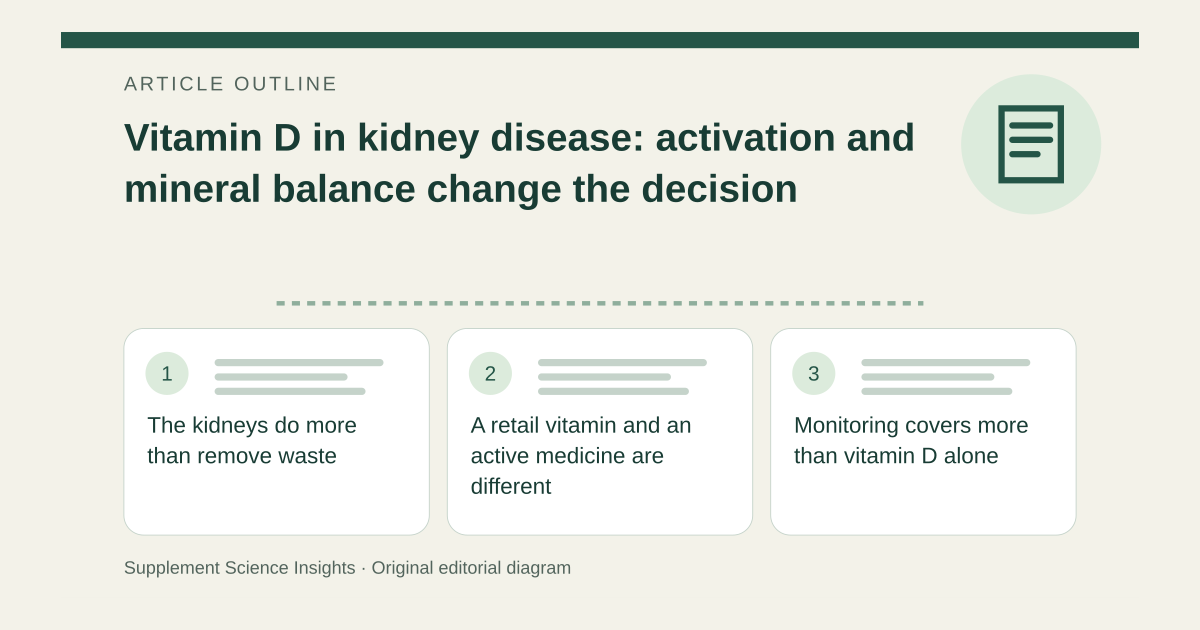
The kidneys do more than remove waste
The kidneys help convert vitamin D into calcitriol, its active form, and regulate calcium and phosphorus balance. In chronic kidney disease, impaired activation and altered mineral handling can contribute to chronic kidney disease–mineral and bone disorder, or CKD-MBD. [1]
This is not simply a question of whether a person gets enough sunlight. NIDDK describes a linked problem involving kidney function, minerals and hormones, including parathyroid hormone. Treating one number without the rest of that context can miss the actual disorder. [1]
A retail vitamin and an active medicine are different
Vitamin D3 in an ordinary supplement still requires processing in the body. Calcitriol is already the active form. NIDDK lists prescribed calcitriol, vitamin D and calcium, and other medicines among possible treatments for mineral and bone disorder, depending on the patient’s needs. [1][2]
The presence of several options is not a recommendation for everyone with CKD to take them all. A retail D3 amount cannot be substituted for a prescribed calcitriol amount using a simple IU conversion. The treatment names describe different preparations and purposes. [1][2]
Monitoring covers more than vitamin D alone
NIDDK describes assessment of calcium, phosphorus, parathyroid hormone and sometimes vitamin D, together with clinical history and other tests when indicated. Dialysis teams adjust nutrition, medicines and supplements using ongoing blood results. [1]
Kidney stage, existing treatment and the direction of mineral abnormalities matter. One person’s successful regimen is not a template for another person with a different pattern of calcium, phosphorus or hormone results. [1]
Two bottles do not answer the same question
Imagine a person on a kidney-treatment plan has prescribed calcitriol and also considers an over-the-counter D3 product. The safe comparison begins by listing both exact preparations and the reason each is proposed. It does not begin by selecting whichever bottle has the larger printed number.
That record gives the kidney team a concrete question about overlap and monitoring. It does not establish that the second product is needed or that it can replace the first.
| Observation | Meaning |
|---|---|
| Prescribed calcitriol | Active vitamin D medicine; retain exact directions |
| Proposed D3 supplement | Separate preparation requiring review |
| Calcium and phosphorus results | Part of the wider treatment context |
Review additions with the kidney team
NIDDK advises discussing vitamin and mineral supplements with the treating professional. Excessive vitamin D can cause hypercalcemia, and mineral imbalance in CKD can affect bones, the heart and blood vessels. Do not add calcium or vitamin D solely on the assumption that more must strengthen bones. [1][2]
This article explains the NIDDK framework and basic activation pathway. It does not select a CKD dose, prescribe an active vitamin D medicine or recommend changing dialysis or phosphate-binder treatment. [1][2]
Sources for this article
- NIDDK — Mineral and Bone Disorder in Chronic Kidney Disease
Source consulted: 2026-09-17. This is a reference resource, not a claim that we conducted the studies or tested a product. - NIH ODS — Vitamin D: Health Professional Fact Sheet
Source consulted: 2026-09-17. This is a reference resource, not a claim that we conducted the studies or tested a product.