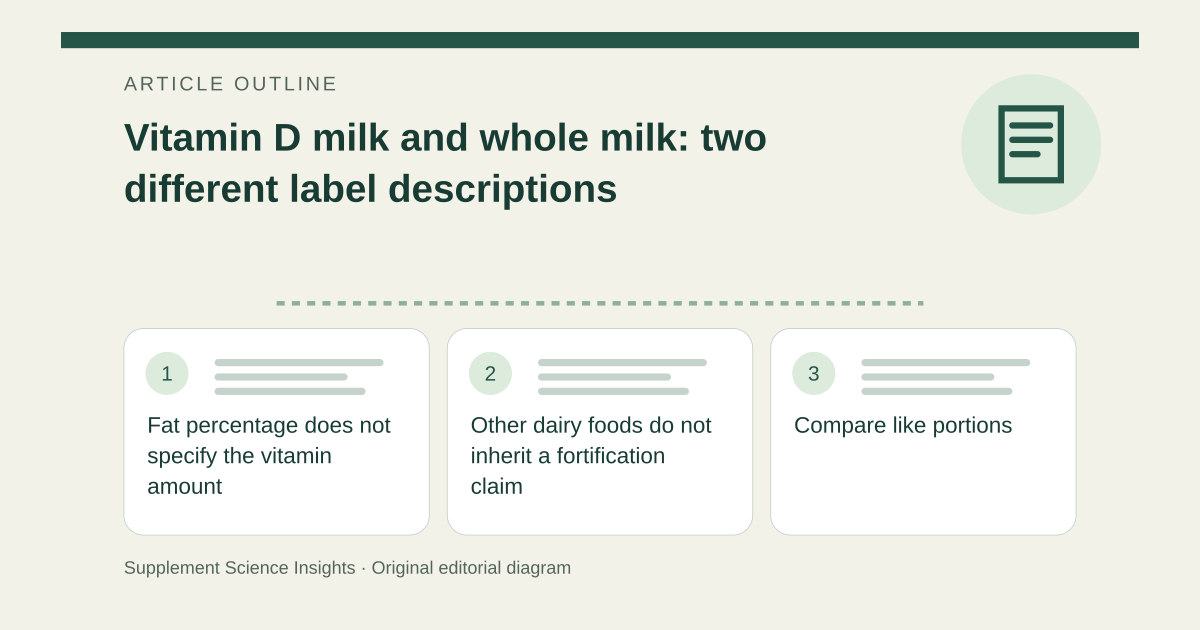
Fat percentage does not specify the vitamin amount
NIH ODS reports that almost all U.S. milk is fortified with vitamin D and gives fortified 2% milk as a food-table example. The terms whole and vitamin D therefore are not interchangeable names for one nutrient profile. [1]
Read the amount per serving on the particular carton. ODS describes about 3 micrograms, or 120 IU, per cup as a common fortified-milk amount, but the actual label is the appropriate basis for a product calculation. [1]
Other dairy foods do not inherit a fortification claim
Cheese and ice cream are not usually fortified simply because they are made from milk. Plant beverages are often fortified, but their composition also varies. Check vitamin D separately from protein, calcium and fat rather than assuming matching one nutrient makes two drinks nutritionally equivalent. [1]
Compare like portions
Imagine two cartons each declare 3 micrograms vitamin D per cup, but one is whole milk and the other is reduced-fat milk. They supply the same declared vitamin D in that portion despite different fat contents. Half a cup supplies half the listed amount.
| Detail | Meaning |
|---|---|
| Whole milk | Fat-content description |
| Fortified | Nutrient added |
| Carton label | Amount for that product |
Sources for this article
- NIH ODS: Vitamin D
Source consulted: 2026-09-17. This is a reference resource, not a claim that we conducted the studies or tested a product.