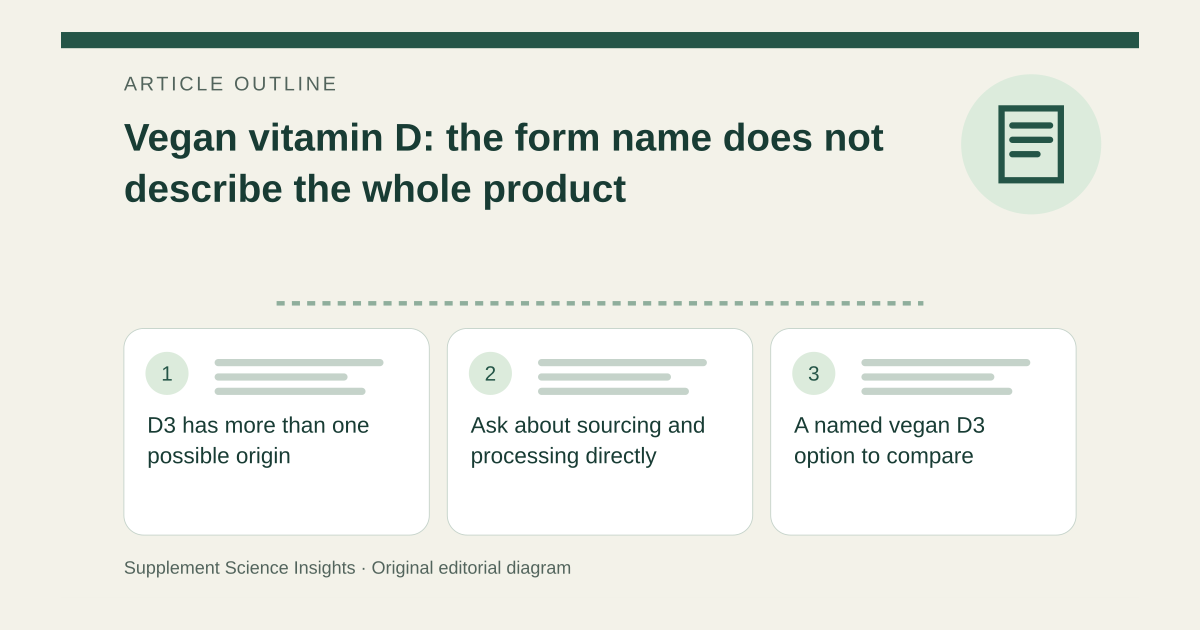
D3 has more than one possible origin
NIH ODS describes vitamin D2 production using ultraviolet irradiation of ergosterol in yeast. It describes conventional D3 production from a lanolin-derived precursor and also notes an animal-free D3 source from lichen. [1]
Consequently, D3 on a label does not by itself mean animal-derived, and D2 does not describe every other component in the finished product. The active vitamin form answers a narrower question than whole-product suitability. [1]
Ask about sourcing and processing directly
ODS advises people avoiding animal-sourced products to ask manufacturers about sourcing and processing. Retain the complete ingredient list and any actual certification rather than inferring a guarantee from the vitamin abbreviation. [1]
Both D2 and D3 can raise blood 25-hydroxyvitamin D. ODS reports that D3 generally produces a greater and more sustained increase, but this does not establish a personal dose or cancel a sourcing preference. Nutritional need and ingredient origin are separate decisions. [1]
A named vegan D3 option to compare
Garden of Life describes its Organics Vegan D3 Organic Spray, Vanilla, as providing 1,000 IU per serving from lichen rather than lanolin. The manufacturer page identifies item 658010117814 and was checked on September 25, 2026. It is a concrete sourcing-and-format option for someone seeking vegan D3, not proof that it is the best product for every adult. [2][3]
The sourcing statement is attributed to the manufacturer; this review did not independently verify the product’s vegan-certification registry or test a batch. Confirm the current package, full ingredient list and directions, and choose the vitamin D amount according to your needs rather than treating the example serving as a prescription. [2][3]
Two D3 labels can answer the origin question differently
Imagine two labels both state D3. One identifies lichen as its source; the other provides no origin. The first contains a specific source declaration, while the second leaves the question unresolved. Neither line alone verifies the capsule shell, processing or actual batch.
| Detail | Interpretation |
|---|---|
| D3 | Chemical form |
| Lichen-derived | A source declaration |
| Complete product vegan status | Requires the remaining product information |
Sources for this article
- NIH ODS: Vitamin D
Source consulted: 2026-09-17. This is a reference resource, not a claim that we conducted the studies or tested a product. - Garden of Life: Organics Vegan D3 Organic Spray 1,000 IU – Vanilla
Source consulted: 2026-09-25. This is a reference resource, not a claim that we conducted the studies or tested a product. - NIH ODS: Vitamin D
Source consulted: 2026-09-25. This is a reference resource, not a claim that we conducted the studies or tested a product.