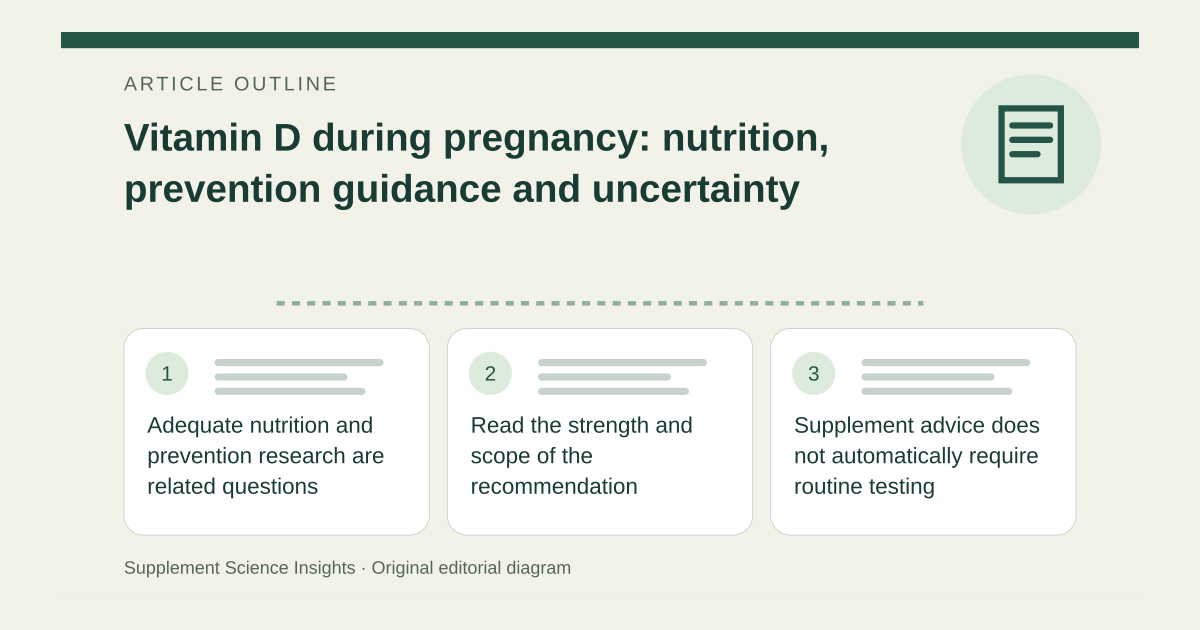
Adequate nutrition and prevention research are related questions
Vitamin D supports calcium absorption and bone mineralization. The U.S. Recommended Dietary Allowance during pregnancy is 15 micrograms, or 600 IU, daily. That total-intake reference is different from a treatment regimen for a diagnosed deficiency. [1]
Research also asks whether supplementation improves pregnancy outcomes beyond basic nutrient adequacy. A plausible biological role does not on its own establish the size or certainty of such benefits. [1]
Read the strength and scope of the recommendation
The Endocrine Society’s 2024 guideline suggests empiric vitamin D supplementation during pregnancy because of potential benefits for several maternal and infant outcomes. The recommendation is conditional and based on low-certainty evidence. It should not be translated into a promise that supplementation prevents preeclampsia or preterm birth for an individual. [2]
Its technical remarks describe intake through fortified foods, a prenatal formulation or a separate supplement. The trial doses varied widely, and their average is a description of the research, not a universal prenatal prescription. The recommendation concerns generally healthy pregnant participants. [2]
Supplement advice does not automatically require routine testing
The same guideline suggests against routine 25-hydroxyvitamin D testing in generally healthy pregnancy without another established indication. It notes that trial evidence has not established a blood threshold that yields pregnancy-specific outcome benefits. [2]
A suspected deficiency, hypocalcemia or another clinical condition is a different scenario. Guidance against routine screening should not be used to cancel a test ordered for a specific medical reason. [2]
Review the prenatal label before adding another product
Suppose a hypothetical prenatal already supplies 600 IU and a separate product supplies another 1,000 IU at the intended serving. Together they would supply 1,600 IU from those two products. The calculation makes overlap visible; it does not establish that the additional amount is needed.
Bring the actual prenatal label and any proposed supplement to the prenatal clinician. A trial average or another person’s pregnancy regimen does not replace that review.
| Observation | Meaning |
|---|---|
| Prenatal: 600 IU | Record the actual serving |
| Additional product: 1,000 IU | A separate proposed exposure |
| Combined product entries: 1,600 IU | Need and suitability still require review |
Avoid borrowing high-dose treatment schedules
Excess vitamin D can raise calcium and cause harm. Nutritional reference values, guideline prevention advice and prescribed deficiency treatment are different tools. Use the plan selected for the pregnancy and its health context rather than treating the largest studied dose as the best one. [1][2]
This page reports authoritative guidance rather than independently appraising every pregnancy trial. It recommends no exact retail product and does not claim guaranteed maternal or infant outcomes. [1][2]
Sources for this article
- NIH ODS — Vitamin D: Health Professional Fact Sheet
Source consulted: 2026-09-17. This is a reference resource, not a claim that we conducted the studies or tested a product. - Endocrine Society — Vitamin D for the Prevention of Disease
Source consulted: 2026-09-17. This is a reference resource, not a claim that we conducted the studies or tested a product.