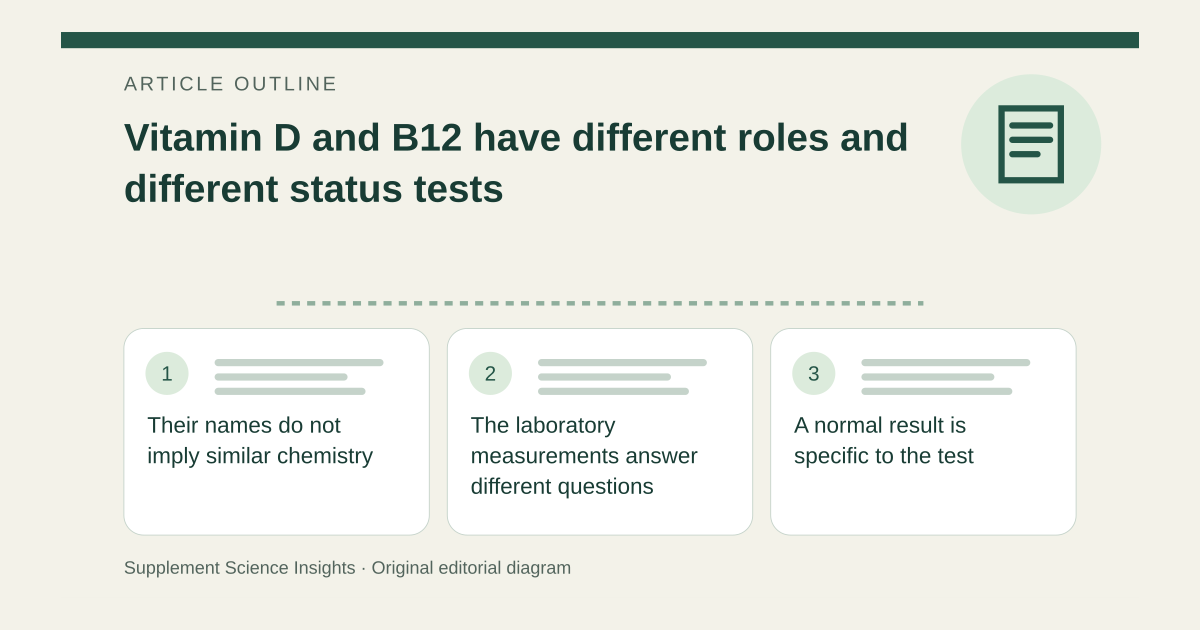
Their names do not imply similar chemistry
Vitamin D helps regulate calcium and phosphate availability for normal bone mineralization. Vitamin B12 is needed for nervous-system function, healthy red blood cell formation and DNA synthesis. Each has additional roles, but neither replaces the other. [1][2]
Their food supply also differs. B12 occurs naturally in animal-derived foods and can be added to fortified foods; vitamin D has relatively few natural food sources and is also obtained through fortification and skin synthesis. A food containing one need not provide much of the other. [1][2]
The laboratory measurements answer different questions
Vitamin D status is usually assessed with serum 25-hydroxyvitamin D. B12 assessment uses B12-related measurements, sometimes with methylmalonic acid to help clarify an uncertain result. The values and units are not interchangeable. [1][2]
Fatigue or another general symptom cannot identify which nutrient, if either, is involved. When both are measured, interpret each finding in its clinical context instead of assuming that correcting one has corrected the other. [1][2]
A normal result is specific to the test
Imagine vitamin D is within the laboratory’s reference range while B12 is low. The vitamin D result does not cancel the B12 finding, and taking additional D3 does not supply missing B12.
| Detail | Interpretation |
|---|---|
| 25-hydroxyvitamin D | Vitamin D assessment |
| B12-related biomarkers | Different nutrient assessment |
| Shared symptom | Does not establish a shared cause |
Sources for this article
- Vitamin D - Health Professional Fact Sheet
Source consulted: 2026-09-19. This is a reference resource, not a claim that we conducted the studies or tested a product. - Vitamin B12 - Health Professional Fact Sheet
Source consulted: 2026-09-19. This is a reference resource, not a claim that we conducted the studies or tested a product.