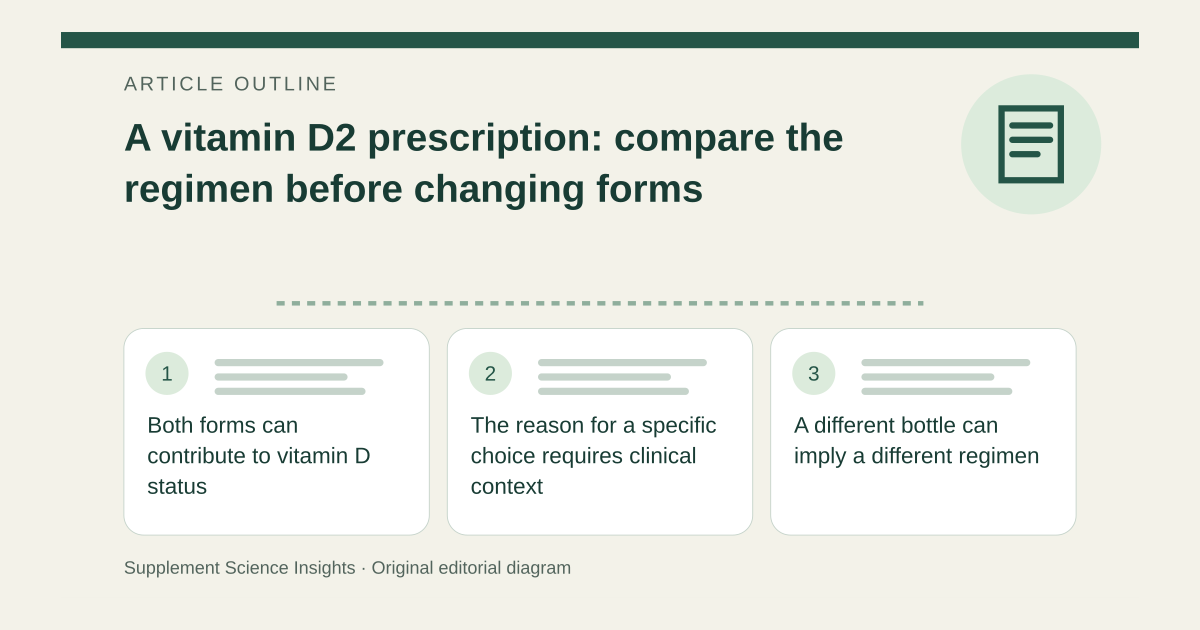
Both forms can contribute to vitamin D status
NIH ODS reports that both D2 and D3 raise serum 25-hydroxyvitamin D. Most comparative evidence favors D3 for raising levels more and maintaining them longer, but that does not make D2 biologically inactive. [1]
The finding concerns a blood-status response. It should not be expanded into a claim that every D2 prescription is ineffective or that every D3 product is preferable for a particular patient. [1]
The reason for a specific choice requires clinical context
Ask the prescriber or pharmacist about the intended treatment purpose, dose, frequency and follow-up. The ingredient name alone cannot reveal why that particular regimen was selected. [1]
Do not substitute a daily retail D3 capsule for an intermittent prescription dose on the assumption that the forms have identical instructions. Form, strength and schedule all belong in the comparison. [1]
A different bottle can imply a different regimen
Imagine someone replaces a prescribed weekly product with a daily product solely because it says D3. Without comparing the actual amounts and instructions, that change may substantially alter the treatment exposure.
| Detail | Interpretation |
|---|---|
| D2 and D3 | Both affect vitamin D status |
| Comparative blood response | Not an individual prescription decision |
| Strength and schedule | Must be checked |
Sources for this article
- Vitamin D - Health Professional Fact Sheet
Source consulted: 2026-09-17. This is a reference resource, not a claim that we conducted the studies or tested a product.