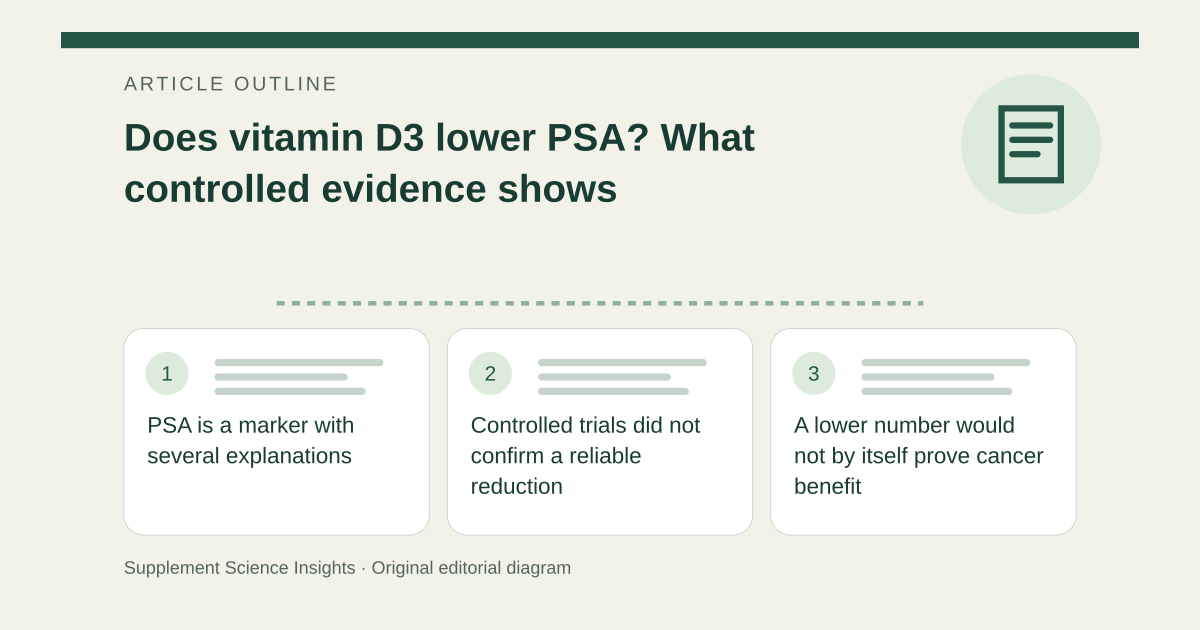
PSA is a marker with several explanations
NCI explains that PSA can rise with prostate cancer but also with benign enlargement or inflammation. A single result does not identify the cause, and there is no one value that proves cancer is present. Follow-up can include a repeat measurement and other assessment based on the clinical situation. [1]
Controlled trials did not confirm a reliable reduction
A systematic review published in 2019 examined vitamin D interventions in people with prostate cancer. Its controlled-trial analysis found no significant differences in PSA change, PSA response or mortality compared with placebo. Favorable before-and-after findings were less informative because changes without a control group cannot isolate treatment effects. [2]
A lower number would not by itself prove cancer benefit
PSA is used in screening discussions and in monitoring after prostate-cancer treatment, but interpretation depends on timing and context. Demonstrating a laboratory change is different from showing improved symptoms, reduced progression or longer survival. The reviewed evidence does not establish vitamin D as prostate-cancer therapy. [1][2]
Treat deficiency for its own reasons
Vitamin D may still be appropriate for nutritional or bone-health needs. That is separate from trying to suppress PSA, and high-dose supplementation can cause serious toxicity. Share supplement use with the clinician interpreting the result rather than delaying recommended follow-up. [3][1]
Do not let a repeat result prove too much
Imagine PSA is lower after a repeat test and a new supplement. PSA varies for several reasons, so the sequence does not establish that D3 caused the change. Continue the agreed evaluation and use the trend in its medical context. [1]
| Evidence | Interpretation |
|---|---|
| Uncontrolled before-and-after decrease | Cannot isolate the supplement effect |
| Controlled trial comparison | Stronger test of efficacy |
| PSA marker change | Not equivalent to improved survival |
| Raised PSA | Needs contextual clinical follow-up |
Sources for this article
- Prostate-Specific Antigen (PSA) Test - NCI
Source consulted: 2026-09-21. This is a reference resource, not a claim that we conducted the studies or tested a product. - The Effect of Vitamin D Supplementation on Prostate Cancer: A Systematic Review and Meta-Analysis of Clinical Trials.
Source consulted: 2026-09-21. This is a reference resource, not a claim that we conducted the studies or tested a product. - Vitamin D - Health Professional Fact Sheet
Source consulted: 2026-09-21. This is a reference resource, not a claim that we conducted the studies or tested a product.