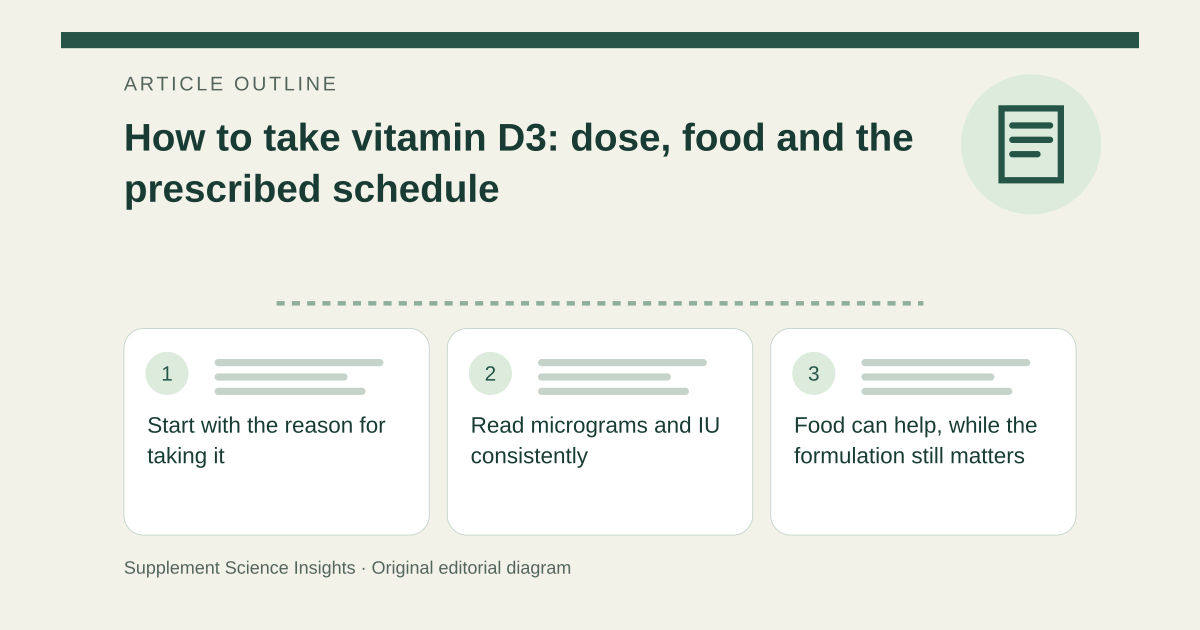
Start with the reason for taking it
For most healthy adults through age 70, the US vitamin D RDA is 600 IU daily from all sources; after 70 it is 800 IU. A prescribed deficiency-treatment course may use different amounts and intervals. Do not interpret a high-dose weekly product as a daily supplement because both contain D3. [1]
Read micrograms and IU consistently
One microgram of vitamin D equals 40 IU. Thus 25 micrograms is 1,000 IU. The general adult upper limit is 100 micrograms, or 4,000 IU, daily from all sources; it is not an intake goal or a substitute for a clinician’s treatment instructions. Include other vitamin D products when adding the total. [1]
Food can help, while the formulation still matters
ODS reports that dietary fat enhances vitamin D absorption, although some is absorbed without fat. Taking a product with an ordinary meal can be practical when its instructions allow. D2 and D3 can both raise vitamin D status, with D3 generally raising and maintaining levels more effectively; this is not proof that the largest D3 capsule is the right choice. [1]
An independently listed vitamin D example
A directory check on September 25, 2026 found Thorne D-5,000 in NSF Certified for Sport: 60- and 120-capsule packages, one-capsule serving; specific certified lots are listed. This is an independently listed quality-check example, not a clinical winner. It does not certify another brand, a different pack or flavor, or an Amazon seller. Recheck the exact entry and your lot before purchase. The high-strength product name does not establish the right daily amount for you. [2][3]
Separate amount from frequency
Imagine one bottle says 25 micrograms per daily serving while a prescribed product has a much larger amount on an intermittent schedule. Do not take both automatically or convert the prescription into daily use. Confirm which product and schedule are intended and whether the ordinary supplement should continue. [1]
| Item | Interpretation |
|---|---|
| 25 micrograms | 1,000 IU |
| High-dose intermittent prescription | Follow its specific frequency; do not assume daily |
Sources for this article
- Vitamin D - Health Professional Fact Sheet
Source consulted: 2026-09-20. This is a reference resource, not a claim that we conducted the studies or tested a product. - NSF Certified for Sport directory: Thorne D-5,000
Source consulted: 2026-09-25. This is a reference resource, not a claim that we conducted the studies or tested a product. - NSF Certified for Sport: what the mark means
Source consulted: 2026-09-25. This is a reference resource, not a claim that we conducted the studies or tested a product.