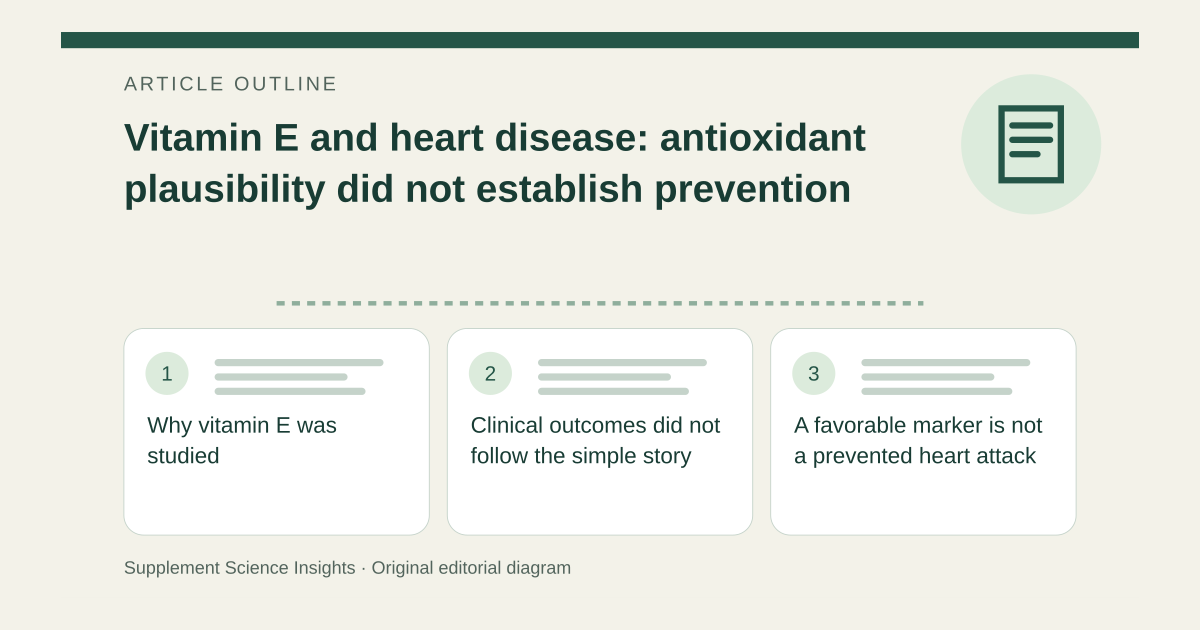
Why vitamin E was studied
Vitamin E has antioxidant activity, and laboratory work suggested ways it might affect processes involved in atherosclerosis. Some observational studies also associated higher intake with lower heart-disease rates. [1]
Those findings created a plausible prevention hypothesis. They did not isolate the effect of taking an additional supplement, because laboratory mechanisms and dietary associations answer different questions from randomized clinical trials. [1]
Clinical outcomes did not follow the simple story
The ODS fact sheet, updated in 2021, concludes that clinical trials have not established that routine vitamin E supplements prevent cardiovascular disease or reduce its illness and death burden. It also describes adverse findings in some trials, including hemorrhagic stroke. [1]
This is not a claim that every preparation or population has identical results. It is a reason not to convert antioxidant activity into a general recommendation for heart protection. This page does not claim a new review of all later studies. [1]
A favorable marker is not a prevented heart attack
Imagine a supplement advertisement describes reduced oxidation in a laboratory test and presents it as proof of fewer heart attacks. The test has not measured that clinical outcome.
The relevant evidence would need the actual intervention, comparison group and cardiovascular events. A mechanism alone cannot provide those results.
| Observation | Interpretation |
|---|---|
| Laboratory antioxidant activity | Mechanistic information |
| Dietary association | Can reflect other differences |
| Randomized clinical events | Tests the prevention intervention more directly |
Do not replace established care with a nutrient claim
Vitamin E can affect bleeding risk and interact with anticoagulant or antiplatelet treatment. A cardiovascular history makes a complete medicine and supplement review important. [1]
Food sources of an essential nutrient and high-dose supplement interventions should not be collapsed into one exposure. Discuss any proposed supplement with the treating clinician rather than changing established prevention or treatment on the strength of a general antioxidant claim. [1]
Sources for this article
- NIH ODS — Vitamin E: Health Professional Fact Sheet
Source consulted: 2026-09-17. This is a reference resource, not a claim that we conducted the studies or tested a product.