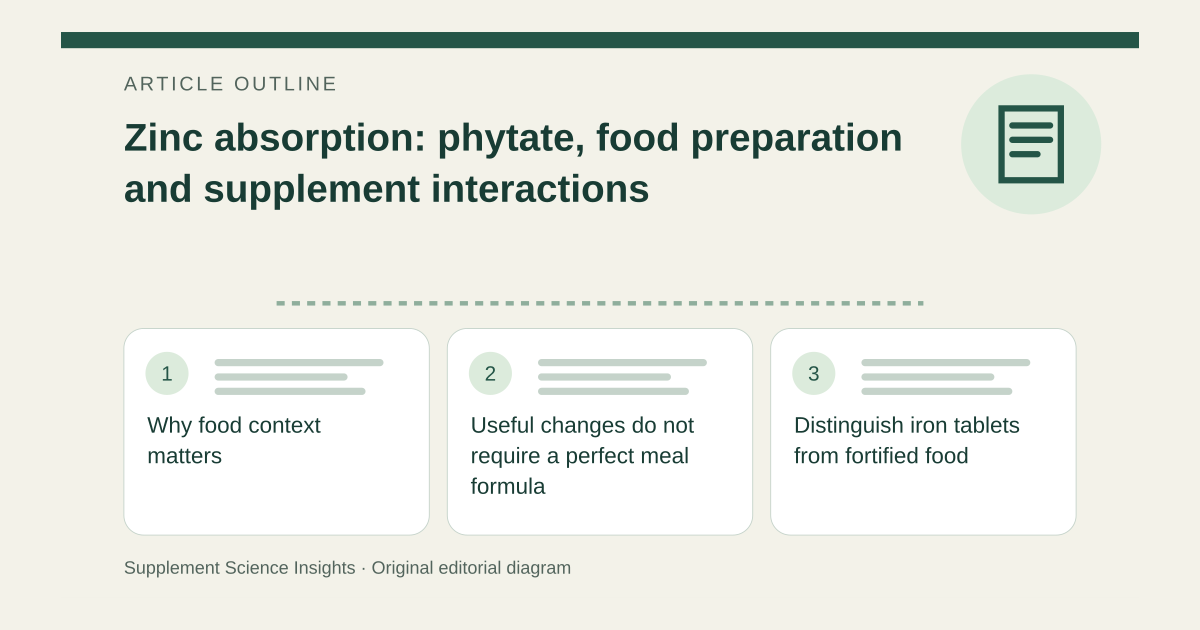
Why food context matters
Zinc from animal foods is generally more bioavailable than zinc from plant foods containing substantial phytate. Phytate can bind zinc in the intestine and reduce absorption. Beans, nuts and whole grains remain useful nutrient sources; reduced availability does not mean they contain no usable zinc. [1]
As zinc intake rises, the amount absorbed can increase while the fraction absorbed falls. This distinction is why doubling a labeled amount does not reliably double the amount retained by the body. [1]
Useful changes do not require a perfect meal formula
ODS describes soaking beans, grains and seeds before cooking as one approach that can reduce phytate binding. Canned or precooked foods are another option, and organic acids in fermented foods may improve absorption. [1]
These are practical food-planning considerations, not a guarantee of a particular absorbed percentage. The effect depends on the food and preparation, so a generic rule cannot convert a mixed meal’s listed zinc into an exact amount absorbed. [1]
Distinguish iron tablets from fortified food
Taking a supplement containing at least 25 mg elemental iron at the same time as zinc can reduce zinc absorption, according to ODS. This is a supplement interaction; the fact sheet does not describe iron in enriched or fortified foods as having the same significant effect. [1]
Do not remove needed iron treatment or zinc-rich foods to solve an assumed conflict. A pharmacist can review the actual preparations and schedule. The elemental amount on the Supplement Facts panel is the relevant label quantity, not the mass of the entire compound. [1]
A menu and a supplement list answer different questions
Imagine someone eats beans regularly and also takes prescribed iron. They ask whether beans must be avoided so a zinc tablet will work. A better review separates ordinary food planning from the dose and timing of the iron supplement.
That distinction can preserve a nutritious food while identifying an interaction that actually depends on concentrated supplemental exposure.
| Question | What it establishes |
|---|---|
| Beans or whole grains | Consider phytate and preparation |
| Concentrated iron supplement | Review actual amount and timing |
| A larger zinc label amount | Does not establish proportional absorption |
Absorption is not a complete efficacy claim
An absorption measurement does not prove better symptom relief or infection prevention. Studies of particular preparations and participants cannot automatically establish the performance of every retail product bearing the same mineral name. [1]
Use absorption information to ask a more precise question about intake or scheduling. It does not establish a universally best zinc form or a reason to keep increasing the dose. [1]
Sources for this article
- NIH ODS — Zinc: Health Professional Fact Sheet
Source consulted: 2026-09-17. This is a reference resource, not a claim that we conducted the studies or tested a product.