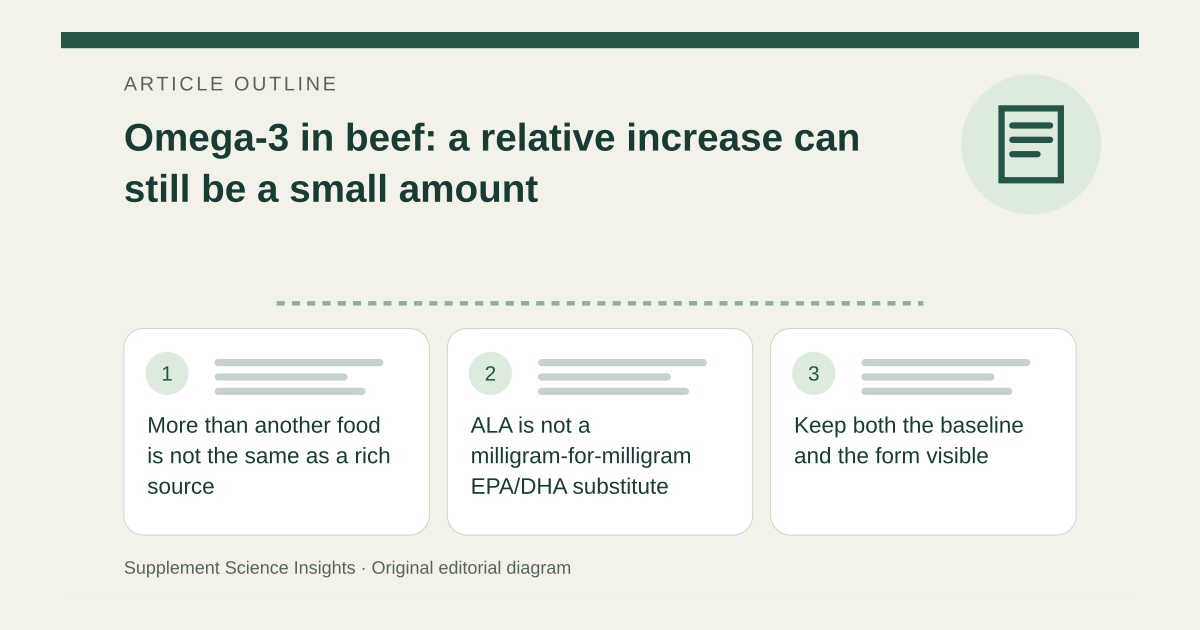
More than another food is not the same as a rich source
NIH ODS describes beef as very low in omega-3s and notes somewhat higher amounts, mainly ALA, in grass-fed beef. The comparison is relative to another beef source. [1]
A relative increase does not tell you the absolute amount in a serving. Both quantities can remain small compared with a different food category. [1]
ALA is not a milligram-for-milligram EPA/DHA substitute
ODS distinguishes plant-associated ALA from EPA and DHA and describes conversion of ALA into the longer-chain forms as limited. The identity of the fatty acid therefore belongs beside the amount. [1]
Do not count an unspecified total omega-3 value as if it were entirely EPA plus DHA. An overall food choice also involves nutrients beyond this single comparison. [1]
Keep both the baseline and the form visible
Imagine one beef sample contains more ALA than another. That difference does not establish the same EPA/DHA supply as a serving of oily fish.
| Detail | Interpretation |
|---|---|
| Relative difference | Compared with another beef sample |
| Absolute amount | Still needs a serving value |
| ALA versus EPA/DHA | Different components |
Sources for this article
- Omega-3 Fatty Acids - Health Professional Fact Sheet
Source consulted: 2026-09-18. This is a reference resource, not a claim that we conducted the studies or tested a product.