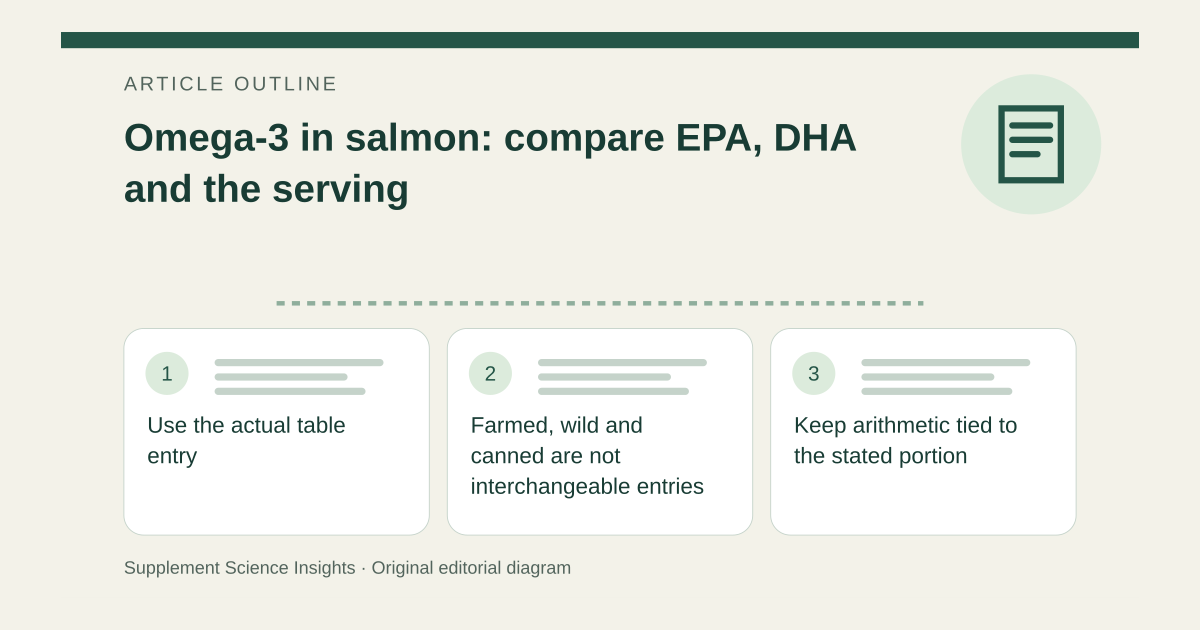
Use the actual table entry
The ODS food table lists a three-ounce serving of cooked farmed Atlantic salmon with 1.24 grams DHA and 0.59 grams EPA. Their sum is 1.83 grams, or 1,830 milligrams, of EPA plus DHA. [1]
For cooked wild Atlantic salmon, the table lists 1.22 grams DHA and 0.35 grams EPA per three ounces, totaling 1.57 grams. These are reference entries, not guarantees for every fillet. [1]
Farmed, wild and canned are not interchangeable entries
Fish fatty-acid content depends partly on what the fish eats. ODS notes that feeding practices can change the EPA and DHA content of farmed fish, so the broad farmed-versus-wild label is not a fixed quality ranking. [1]
Its drained canned pink salmon entry also differs from the cooked Atlantic salmon entries. Preserve species, preparation and portion when comparing food records. [1]
Keep arithmetic tied to the stated portion
Imagine a meal log uses the farmed Atlantic entry for a three-ounce cooked portion. Adding 1.24 and 0.59 gives the combined EPA-plus-DHA value for that entry, not the amount of total fat.
If the actual serving or preparation differs, the estimate changes. A database calculation cannot verify the precise content of the food on a particular plate.
| Detail | Interpretation |
|---|---|
| DHA: 1.24 g | One listed component |
| EPA: 0.59 g | The other listed component |
| Combined: 1.83 g | 1,830 mg per specified serving |
A nutrient amount is not a treatment dose
The presence of EPA and DHA makes salmon a dietary source, but its composition alone does not establish that one meal treats a disease. Food also supplies nutrients other than these two fatty acids. [1]
This page compares composition and units. It does not equate a serving of salmon with a specific prescription or retail oil product. [1]
Sources for this article
- NIH ODS: Omega-3 Fatty Acids
Source consulted: 2026-09-17. This is a reference resource, not a claim that we conducted the studies or tested a product.