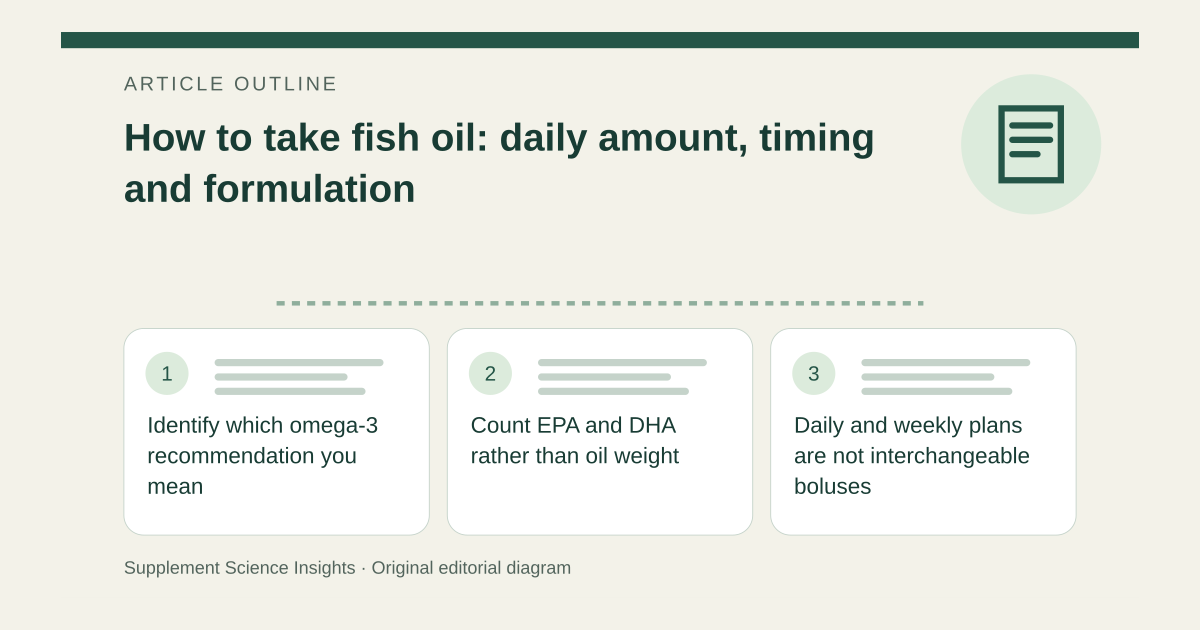
Identify which omega-3 recommendation you mean
NIH adult adequate intakes of 1.6 g for men and 1.1 g for women refer to ALA, the plant-associated essential omega-3, not a required fish-oil dose. No equivalent universal dietary requirement for EPA plus DHA has been established. A woman aged 65 does not acquire a standard fish-oil prescription solely because of her age. [1]
Count EPA and DHA rather than oil weight
A label may show 1,000 mg of fish oil but substantially less combined EPA and DHA. Add the declared EPA and DHA for the full serving; check whether the serving is one capsule or several. Liquid, ethyl-ester, triglyceride and other preparations should be used according to their own directions rather than exchanged by capsule count. [1][2]
Daily and weekly plans are not interchangeable boluses
If a clinician selects a daily amount, seven times that amount describes a weekly total, not permission to swallow it all at once. Weekly seafood advice is a dietary pattern and cannot automatically be converted into a supplement dose. Follow product or prescription instructions, including any directions about food or divided doses. The guidance cited here establishes no universal morning-versus-night advantage. [1][3]
What daily use might change
The effect depends on formulation, amount and purpose. Omega-3s can lower triglycerides, particularly in prescription treatment, but routine supplements do not guarantee prevention of heart attacks or a noticeable daily sensation. Common adverse effects include fishy taste, heartburn, nausea and diarrhea. [1]
More is not a general health strategy
Higher-dose regimens need medical oversight, particularly with anticoagulants or a history of atrial fibrillation. NIH describes an increased atrial-fibrillation risk in some high-dose cardiovascular trials. Safety ceilings are not daily targets. Review the reason for use and the complete medication list before escalating. [1]
Calculate the label before changing the routine
Imagine a hypothetical two-capsule serving declares 360 mg EPA and 240 mg DHA. That serving supplies 600 mg combined, not whatever larger total-oil number appears on the front. The arithmetic identifies the contents; it does not determine whether that amount is appropriate for the person. [1][4]
| Declared amount | Calculation |
|---|---|
| EPA 360 mg plus DHA 240 mg | 600 mg combined per serving |
| Serving is two capsules | 300 mg combined per capsule |
| Weekly equivalent if prescribed daily | Not a once-weekly dosing instruction |
Sources for this article
- Omega-3 Fatty Acids - Health Professional Fact Sheet
Source consulted: 2026-09-21. This is a reference resource, not a claim that we conducted the studies or tested a product. - Dietary Supplements: What You Need to Know
Source consulted: 2026-09-21. This is a reference resource, not a claim that we conducted the studies or tested a product. - Advice about Eating Fish | FDA
Source consulted: 2026-09-21. This is a reference resource, not a claim that we conducted the studies or tested a product. - How to Understand and Use the Nutrition Facts Label | FDA
Source consulted: 2026-09-21. This is a reference resource, not a claim that we conducted the studies or tested a product.