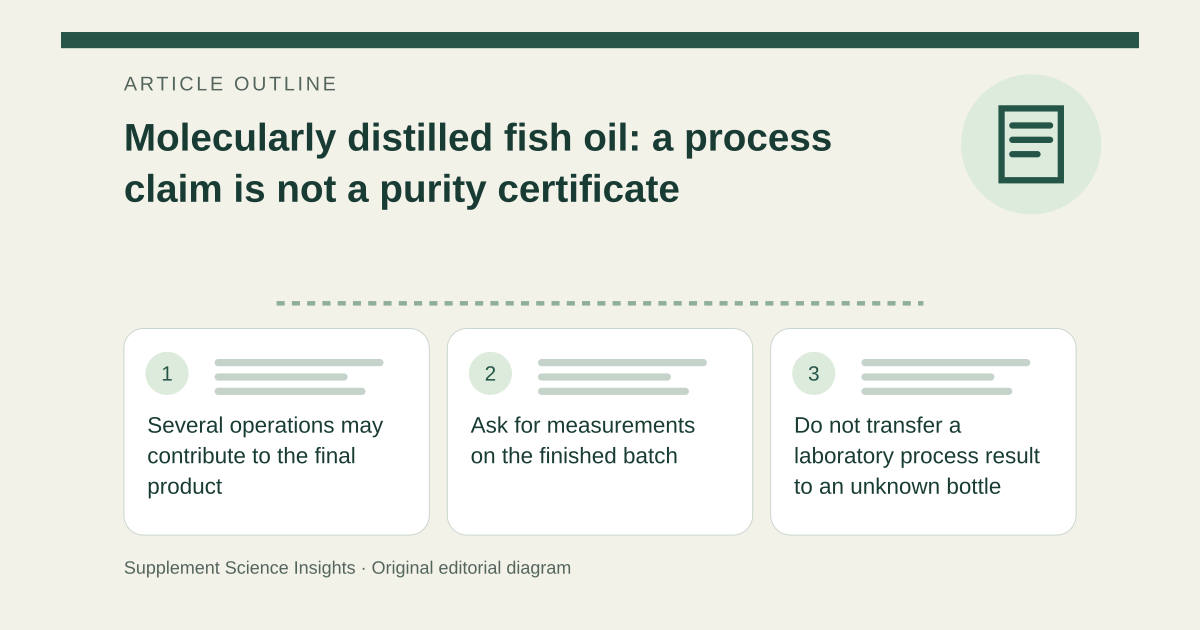
Several operations may contribute to the final product
A processing study produced high-purity EPA ethyl ester using a sequence that included esterification, urea complexation, molecular distillation and column separation. Its final purity result followed the integrated process, not distillation alone. [1]
The authors also varied process conditions and added an antioxidant during production. That is a manufacturing experiment, not proof that every retail product using the same processing term has the same composition. [1]
Ask for measurements on the finished batch
The Codex fish-oil standard addresses separate characteristics such as composition and oxidation. A processing description does not replace those measurements or establish the absence of every possible contaminant. [2][1]
A useful comparison identifies the final chemical form, EPA/DHA amount and relevant batch testing. High concentration of one fatty acid and low oxidation are different properties; neither automatically follows from a front-label distillation claim. [2][1]
Do not transfer a laboratory process result to an unknown bottle
Imagine a paper reports a high-purity fraction after several purification steps. A retail bottle naming only one of those steps cannot inherit the paper’s numerical result.
| Detail | Interpretation |
|---|---|
| Process name | How a material was treated |
| Composition test | What the final material contains |
| Oxidation test | A separate quality measure |
Sources for this article
- Effects of Addition of Tea Polyphenol Palmitate and Process Parameters on the Preparation of High-Purity EPA Ethyl Ester - PubMed
Source consulted: 2026-09-19. This is a reference resource, not a claim that we conducted the studies or tested a product. - fish-codex-standard
Source consulted: 2026-09-19. This is a reference resource, not a claim that we conducted the studies or tested a product.