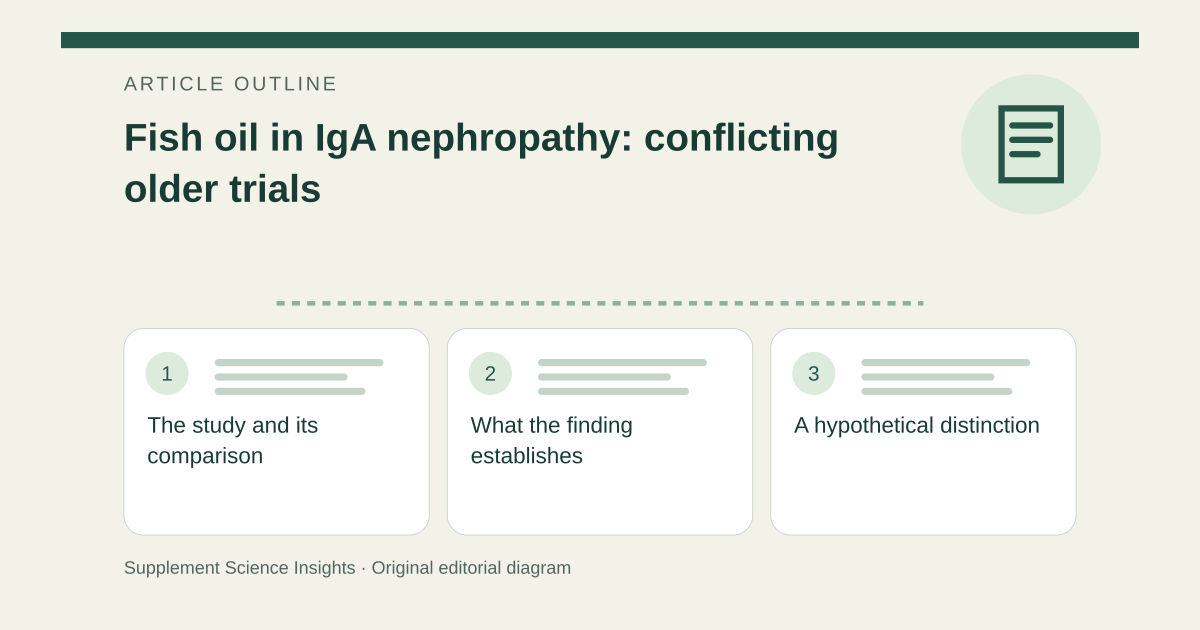
The study and its comparison
The randomized research included 106 participants. Its population was patients with iga nephropathy and persistent proteinuria. The comparison used fish oil 12 g daily versus olive-oil placebo, with observation over two years, with longer clinical follow-up. [1][2]
The larger trial found fewer substantial creatinine rises with fish oil. However, a separate six-month study with thirty-two completers found no urinary-protein benefit and reported a within-group decline in filtration with its omega-3 preparation. [1][2]
What the finding establishes
The smaller study used a different concentrated preparation and corn-oil comparator. Its within-group decline is not automatically proof of between-group harm. Different durations, formulations and small cohorts limit synthesis. These historical trials cannot establish a current kidney-treatment recommendation or equate total fish-oil mass with EPA plus DHA. Funding and complete conflicts were not established from the retrieved abstract. [1][2]
A hypothetical distinction
Imagine two trials use the same broad supplement label but different concentrations and comparators. Treating them as identical interventions obscures important uncertainty.
| Detail | Interpretation |
|---|---|
| Measured outcome | Keep the endpoint specific |
| Study preparation | Not every retail product |
| Remaining uncertainty | Not resolved by a mechanism |
Sources for this article
- A controlled trial of fish oil in IgA nephropathy. Mayo Nephrology Collaborative Group.
Source consulted: 2026-09-19. This is a reference resource, not a claim that we conducted the studies or tested a product. - Treatment of IgA nephropathy with omega-3-polyunsaturated fatty acids: a prospective, double-blind, randomized study.
Source consulted: 2026-09-19. This is a reference resource, not a claim that we conducted the studies or tested a product.