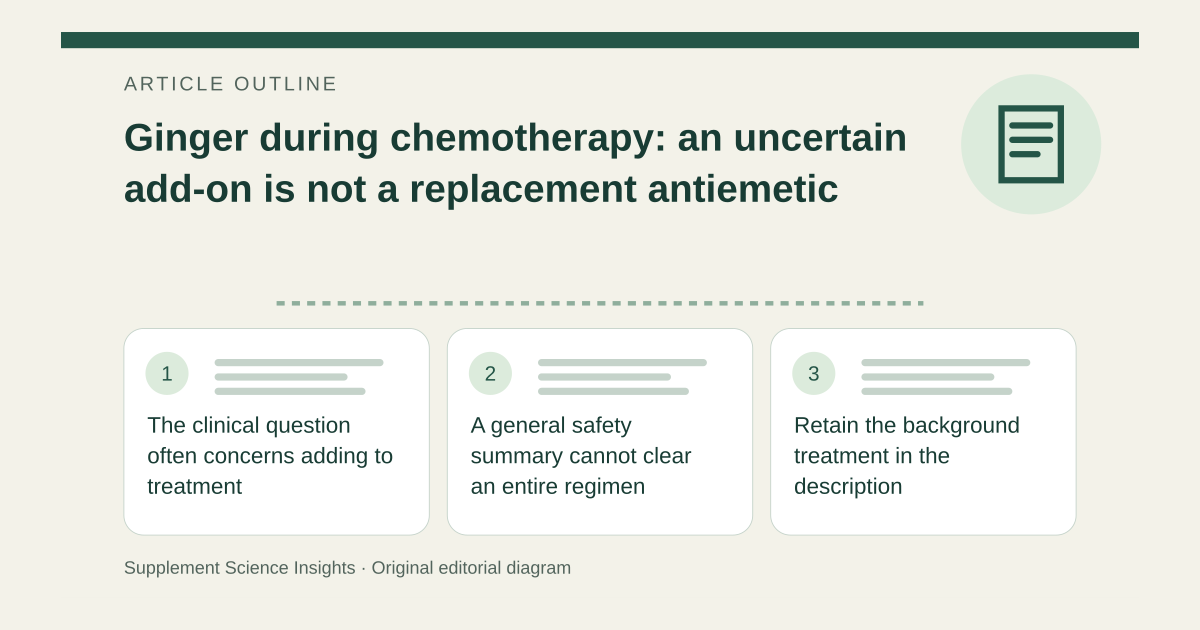
The clinical question often concerns adding to treatment
NCCIH states that it is uncertain whether ginger is a helpful addition to standard treatment for nausea and vomiting associated with cancer chemotherapy. That wording matters: an add-on study does not show that ginger can replace the prescribed antiemetic. [1]
Nausea intensity and vomiting frequency are also different outcomes. Improvement in one should not be rewritten as complete prevention of both, particularly when the study population and chemotherapy regimen differ from the reader’s situation. [1]
A general safety summary cannot clear an entire regimen
NCCIH advises discussing herbal products with the healthcare provider because herbs and medicines can interact. Its ginger summary does not provide a regimen-by-regimen compatibility assessment, and absence of a listed interaction is not such an assessment. [1]
Bring the exact supplement or drink ingredients to the oncology team, including other herbs. Ginger-related digestive irritation can also matter during treatment. This page neither identifies a safe universal dose nor recommends changing chemotherapy or supportive medicines. [1]
Retain the background treatment in the description
Imagine both arms of a nausea trial receive an antiemetic and one arm also receives ginger. Even if the ginger arm improves, the comparison tests an addition. It leaves replacement of the antiemetic unanswered.
| Question | What matters |
|---|---|
| Antiemetic in both groups | Background care |
| Ginger in one group | Additional intervention |
| Ginger alone instead | Not the tested comparison |
Sources for this article
- NCCIH: Ginger
Source consulted: 2026-09-17. This is a reference resource, not a claim that we conducted the studies or tested a product.