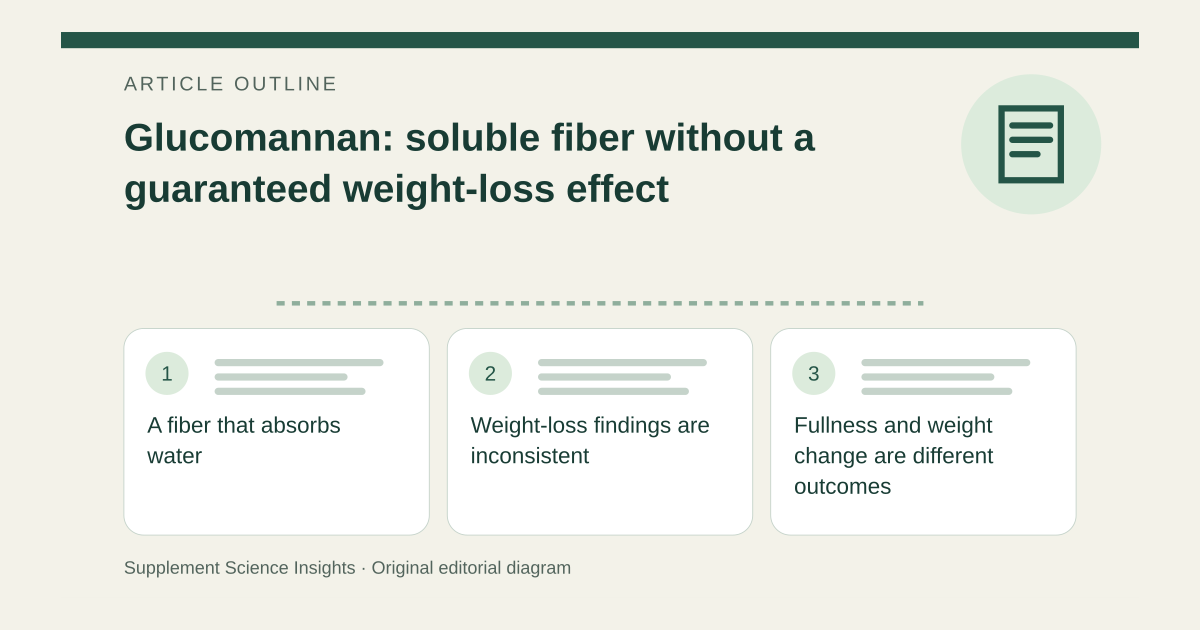
A fiber that absorbs water
Glucomannan is a soluble dietary fiber obtained from konjac root. Its ability to absorb water explains interest in fullness, digestion and weight management. That physical property is a starting point for research, not proof of sustained weight loss. [1]
The form matters. A food made with konjac, a capsule, a powder and a compressed tablet should not be treated as identical products simply because the ingredient name appears on each. [1]
Weight-loss findings are inconsistent
The NIH Office of Dietary Supplements describes mixed results across trials. Some studies found a small weight difference, while others did not. Several reviews did not find a significant effect compared with placebo. This does not support a reliable promise that adding glucomannan will produce a particular amount of weight loss. [1]
The comparison diet, duration and participants matter. A study measuring blood lipids or glucose is not primarily a test of durable weight management. Likewise, a statistically detectable short-term weight difference may be too small or uncertain to support a strong consumer claim. [1]
Fullness and weight change are different outcomes
A product might be studied for how full people feel after a meal, how much they eat at the next meal, or how their weight changes over weeks. These outcomes are related questions, but they are not interchangeable answers.
When reading a headline, identify the measured endpoint first. Then ask how long the study lasted and whether the comparison group made the same other dietary changes. A before-and-after photograph supplies none of those controls and cannot establish an ingredient effect.
Pay attention to swallowing and gastrointestinal effects
ODS reports bloating, gas, loose stools, diarrhea, constipation and abdominal discomfort in short-term use. Long-term safety is not well established. Esophageal obstruction has been reported with glucomannan tablets; the historical reports should not be ignored simply because the ingredient is described as fiber. [1]
Someone with swallowing difficulty or a digestive disorder should seek clinical advice before using a swelling fiber product. Follow the actual preparation instructions, and do not improvise by taking dry powder or compressed tablets as a shortcut. [1]
Read the difference between groups
Imagine a hypothetical trial in which a supplement group loses two kilograms and a comparison group loses 1.5 kilograms while both follow the same dietary program. The difference between groups is half a kilogram, not two kilograms.
You would still need the sample size, uncertainty, adverse effects and duration to judge that difference. This example is arithmetic, not a reported glucomannan result, and it does not establish a personal expectation. The percentage headline should always be traced back to its comparison.
| Hypothetical result | Amount |
|---|---|
| Supplement group loss | 2 kg |
| Comparison group loss | 1.5 kg |
| Between-group difference | 0.5 kg |
Sources for this article
- NIH ODS — Dietary Supplements for Weight Loss, professional fact sheet
Source consulted: 2026-09-17. This is a reference resource, not a claim that we conducted the studies or tested a product.