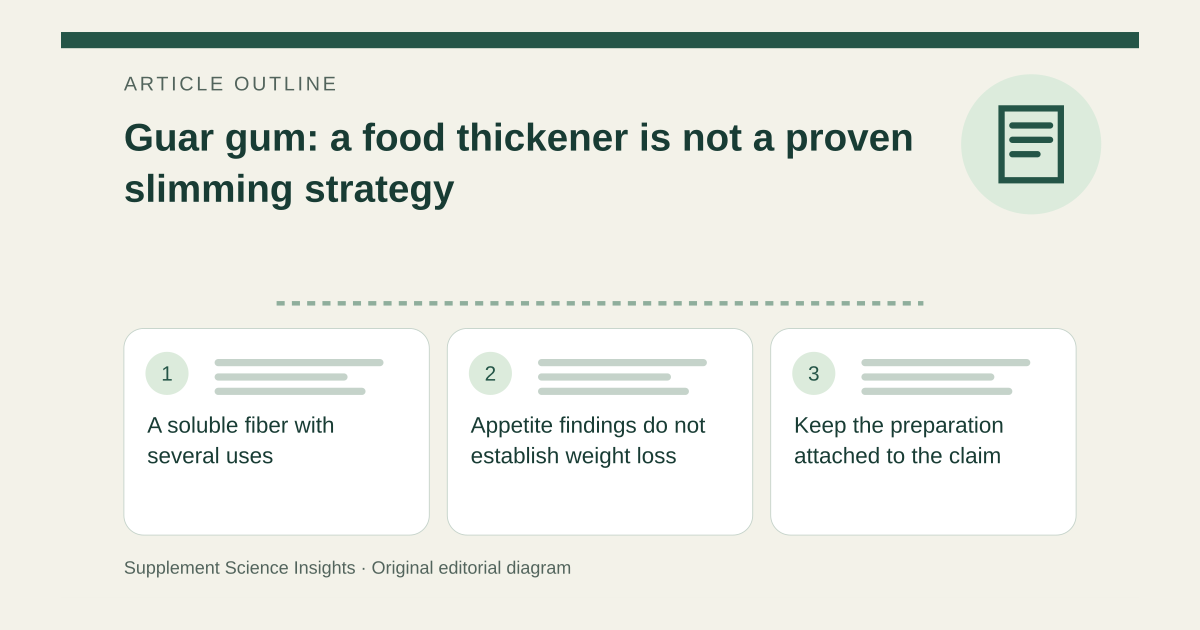
A soluble fiber with several uses
Guar gum comes from the seeds of the cluster bean. It is used as a thickener in foods and is also sold in fiber supplements. Its ability to hold water and alter texture explains some of its uses, but a useful manufacturing property is not evidence of a clinical benefit. [1]
A small quantity in a prepared food is a different context from taking a concentrated supplement. Identify the product and its intended use before comparing evidence. [1]
Appetite findings do not establish weight loss
The NIH Office of Dietary Supplements concludes that guar gum does not appear to enhance weight loss. Studies assessing fullness or snacking behavior should not be rewritten as proof of a lasting reduction in body weight. [1]
Trials differ in participants, doses, duration and dietary advice. The summary includes studies in people with metabolic conditions as well as healthy volunteers, which limits simple generalizations. A change in waist circumference without a corresponding weight change is another distinct outcome, not permission to advertise a universal slimming effect. [1]
Keep the preparation attached to the claim
A label may specify a processed form rather than plain guar gum. Do not assume that research on one preparation proves every claim for another. The actual formulation, amount and purpose must be matched before drawing a conclusion.
If a seller cites a study, check whether it tested the ingredient as used in that product, a food containing it, or a larger intervention. A shared ingredient name is useful identification, but it is not a substitute for an equivalent intervention.
Fluid and form are meaningful details
Reported adverse effects include abdominal discomfort, gas, diarrhea, nausea and cramps. ODS describes historical reports of esophageal or bowel obstruction when a now-discontinued guar product was taken without enough fluid. These reports do not establish that every modern food containing guar carries the same risk, but they explain why preparation instructions matter. [1]
Discuss concentrated fiber products with a clinician if swallowing problems or digestive disease are present. Do not interpret the familiarity of a food additive as blanket approval to take larger amounts on its own. [1]
A food label and a supplement label answer different questions
Imagine a prepared food lists guar gum among its ingredients but does not disclose the amount. A fiber supplement separately lists three grams per serving. The food label confirms presence; it does not establish the same exposure as the supplement.
There is no defensible way to calculate the missing quantity from ingredient order alone. Keep the food's nutritional role, the supplement's declared amount and the evidence for the intended outcome as three separate questions when comparing them.
| Hypothetical label | Known | Unknown |
|---|---|---|
| Prepared food | Guar is present | Exact guar quantity |
| Supplement | 3 g per serving | Whether this preparation matches a relevant study |
Sources for this article
- NIH ODS — Dietary Supplements for Weight Loss, professional fact sheet
Source consulted: 2026-09-17. This is a reference resource, not a claim that we conducted the studies or tested a product.