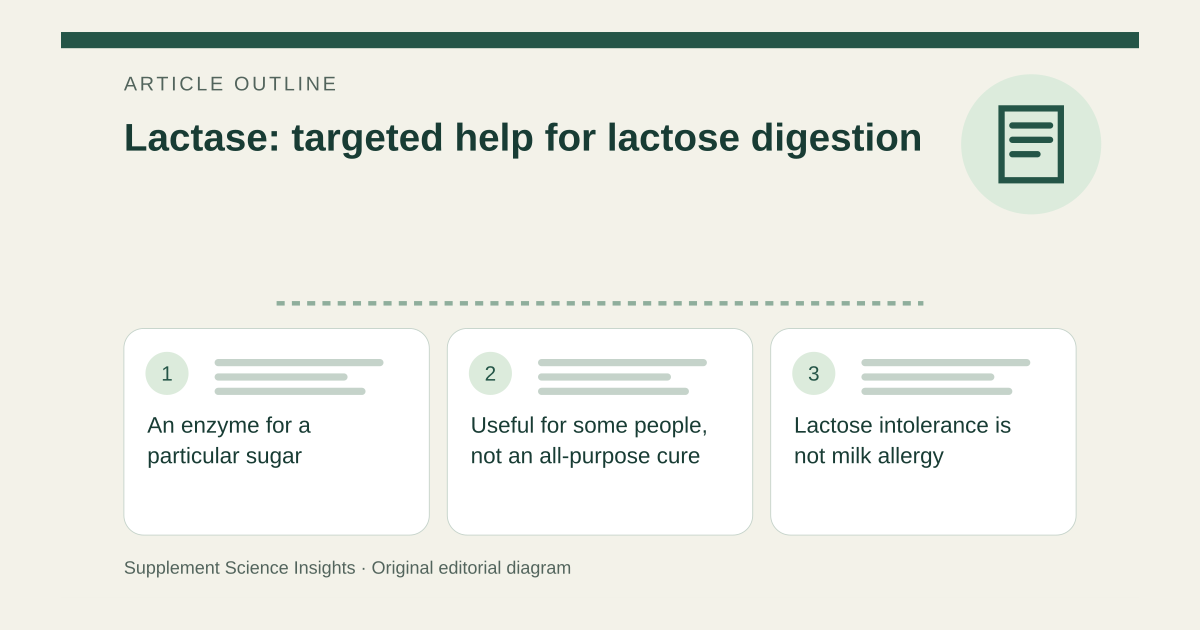
An enzyme for a particular sugar
Lactase breaks down lactose, the sugar in milk and many dairy foods. Lactose intolerance can occur when the small intestine produces too little lactase to digest the amount consumed. Symptoms may include gas, bloating and diarrhea. [1][2]
Supplemental lactase is available in tablets and drops. It is intended to help digest lactose; it does not replace every digestive enzyme or address every cause of abdominal discomfort. [1][2]
Useful for some people, not an all-purpose cure
NIDDK describes lactase products as an option that may help some people manage lactose-intolerance symptoms. Individual tolerance varies, and changing the amount or type of lactose-containing food can also matter. Needing less lactose is not necessarily the same as needing to avoid all dairy. [1]
A response to a lactase product should be interpreted in the context of the meal. Changing the food, portion size and enzyme at the same time makes it difficult to know which change helped. Persistent symptoms despite limiting lactose warrant assessment for other explanations. [1]
Lactose intolerance is not milk allergy
Milk allergy is an immune reaction to milk proteins. Lactase acts on lactose, not those proteins, so it does not make milk safe for someone with milk allergy. A lactose-free dairy product can still contain milk proteins. [2]
This distinction is particularly important when choosing products for a child or interpreting a previous reaction. Do not use an enzyme trial as a way to test whether a suspected allergy has disappeared. [2]
Use the product's directions and the right diagnosis
Different tablets and drops have different instructions. NIDDK advises speaking with a doctor before using lactase products in young children or during pregnancy or breastfeeding. If avoiding dairy substantially, consider how calcium and vitamin D needs will be met within the overall diet. [1]
Do not assume that worsening or unexplained digestive symptoms simply require more enzyme. The appropriate response depends on what is causing the symptoms, not just on whether dairy was eaten recently. [1]
A symptom record can separate questions
Imagine someone changes from a large milk drink to a smaller lactose-free drink and adds a lactase tablet on the same day. If symptoms improve, the observation cannot establish that the tablet caused the improvement: both the lactose exposure and the product changed.
A useful record notes the food, amount, timing, product instructions and symptoms. It supports a discussion with a clinician; it is not a controlled experiment or a substitute for diagnosis. In particular, it should never be used to justify exposure to a suspected food allergen. The record is most useful when it captures the actual serving rather than simply saying that dairy was consumed.
| Hypothetical change | Why attribution is uncertain |
|---|---|
| Smaller drink | Different amount consumed |
| Lactose-free choice | Different lactose exposure |
| Added tablet | Another simultaneous change |
Sources for this article
- NIDDK — Treatment for Lactose Intolerance
Source consulted: 2026-09-17. This is a reference resource, not a claim that we conducted the studies or tested a product. - NIDDK — Definition and Facts for Lactose Intolerance
Source consulted: 2026-09-17. This is a reference resource, not a claim that we conducted the studies or tested a product.