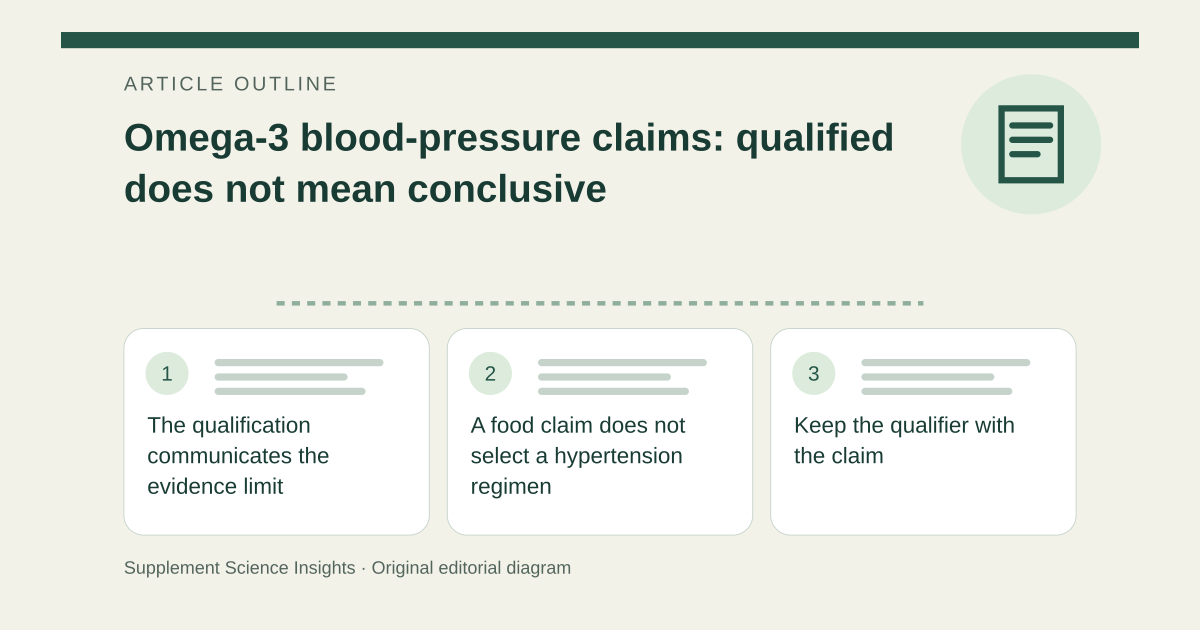
The qualification communicates the evidence limit
FDA explained that the evidence met a credible-evidence standard for a qualified claim but not the stronger standard for an authorized health claim. The distinction is part of how the claim should be understood. [1]
This historical regulatory decision is not a complete review of every later blood-pressure study. It explains why citing FDA without the qualification can overstate what the agency concluded. [1]
A food claim does not select a hypertension regimen
A qualified claim does not establish the personally appropriate amount, formulation or expected change in blood pressure. It also does not establish equivalence between an ordinary supplement and prescribed treatment. [1]
Continue the agreed blood-pressure monitoring and treatment plan. Any proposed supplement addition should be assessed using the actual preparation and relevant health context. [1]
Keep the qualifier with the claim
Imagine an advertisement replaces may reduce risk with treats high blood pressure. The stronger wording is not justified by this qualified-claim decision.
| Detail | Interpretation |
|---|---|
| Qualified claim | Evidence has stated limitations |
| Treatment promise | Different level of claim |
| Individual regimen | Requires clinical context |
Sources for this article
- FDA Announces New Qualified Health Claims for EPA and DHA Omega-3 Consumption and the Risk of Hypertension and Coronary Heart Disease | FDA
Source consulted: 2026-09-18. This is a reference resource, not a claim that we conducted the studies or tested a product.