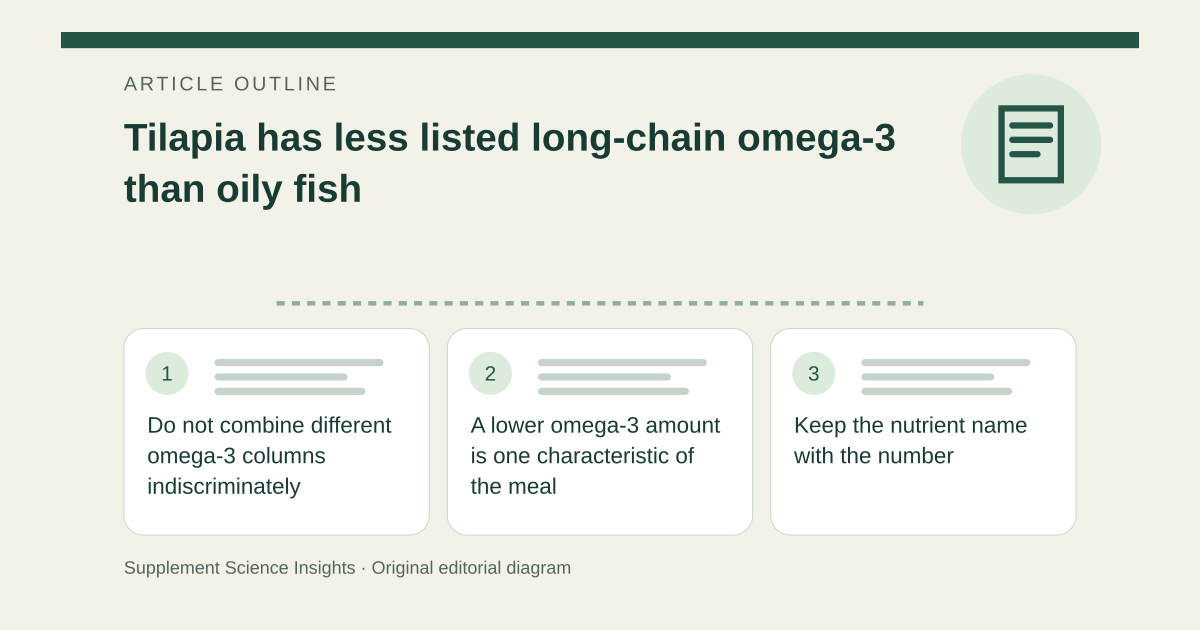
Do not combine different omega-3 columns indiscriminately
The tilapia entry lists 0.11 grams DHA and 0.04 grams ALA, with the EPA field blank. A blank field in this summary should not be converted into a claim of analytically proven zero EPA. [1]
For comparison, the table lists 1.83 grams EPA plus DHA in three ounces of cooked farmed Atlantic salmon and 1.02 grams in cooked Atlantic mackerel. ALA is a different fatty acid, so it should not be presented as an identical amount of EPA or DHA. [1]
A lower omega-3 amount is one characteristic of the meal
FDA/EPA includes tilapia among Best Choices in its mercury guidance. That classification does not mean it has the highest omega-3 concentration; mercury and nutrient composition are different comparisons. [2][1]
Choose the comparison that matches the question. If the goal is a particular EPA/DHA contribution, identify that contribution directly instead of treating all fish servings as equivalent. [2][1]
Keep the nutrient name with the number
Imagine a meal record combines 110 mg DHA and 40 mg ALA into 150 mg EPA plus DHA. The arithmetic adds correctly, but the nutrient label is wrong because ALA is not EPA.
| Detail | Interpretation |
|---|---|
| DHA | 110 mg in the listed serving |
| ALA | 40 mg, a different fatty acid |
| EPA field | Blank in this summary |
Sources for this article
- Omega-3 Fatty Acids - Health Professional Fact Sheet
Source consulted: 2026-09-19. This is a reference resource, not a claim that we conducted the studies or tested a product. - Advice about Eating Fish | FDA
Source consulted: 2026-09-19. This is a reference resource, not a claim that we conducted the studies or tested a product.